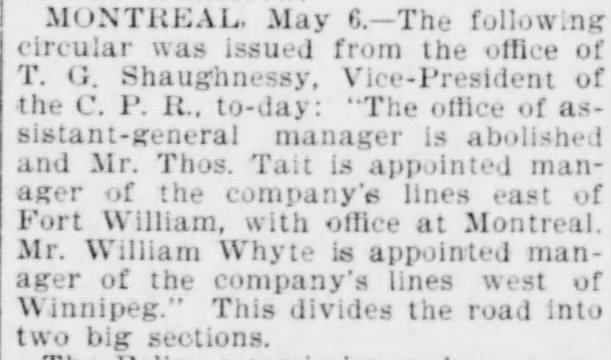
Dividing eastern and western management
A short report on the division of CPR management between Thomas Tait in the east and Whyte in the west.
The newspaper collection · 1897–1941
51 saved clippings: interviews, reports, tributes and the wider railway world.
Catalogue titles are descriptive. Notes draw on the newspapers' extracted text, which can contain errors; the scans remain the source. Duplicate clippings and contextual advertisements are retained and identified.
51 clippings
A short report on the division of CPR management between Thomas Tait in the east and Whyte in the west.
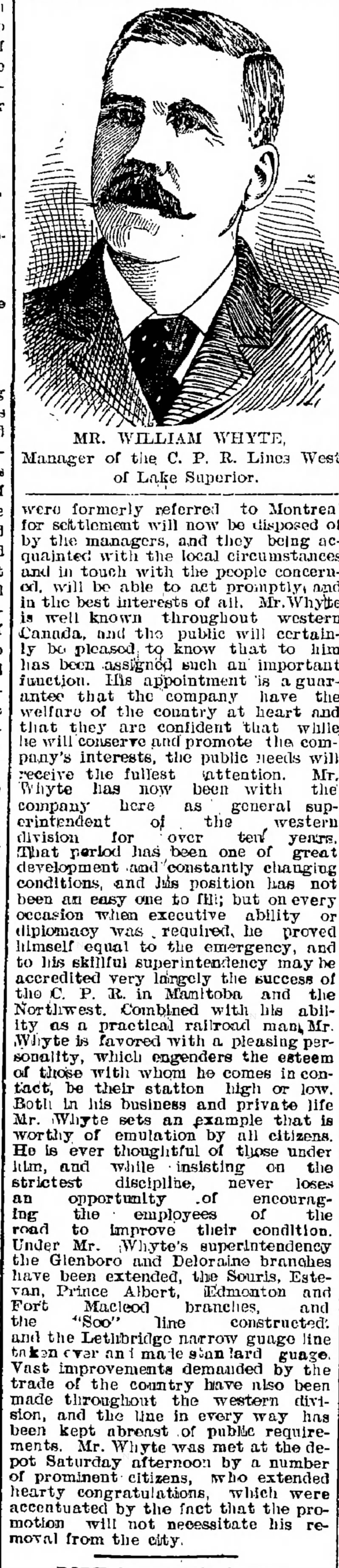
Discusses Whyte's promotion and local decision-making for railway operations west of Lake Superior. Praises his discipline and manner.
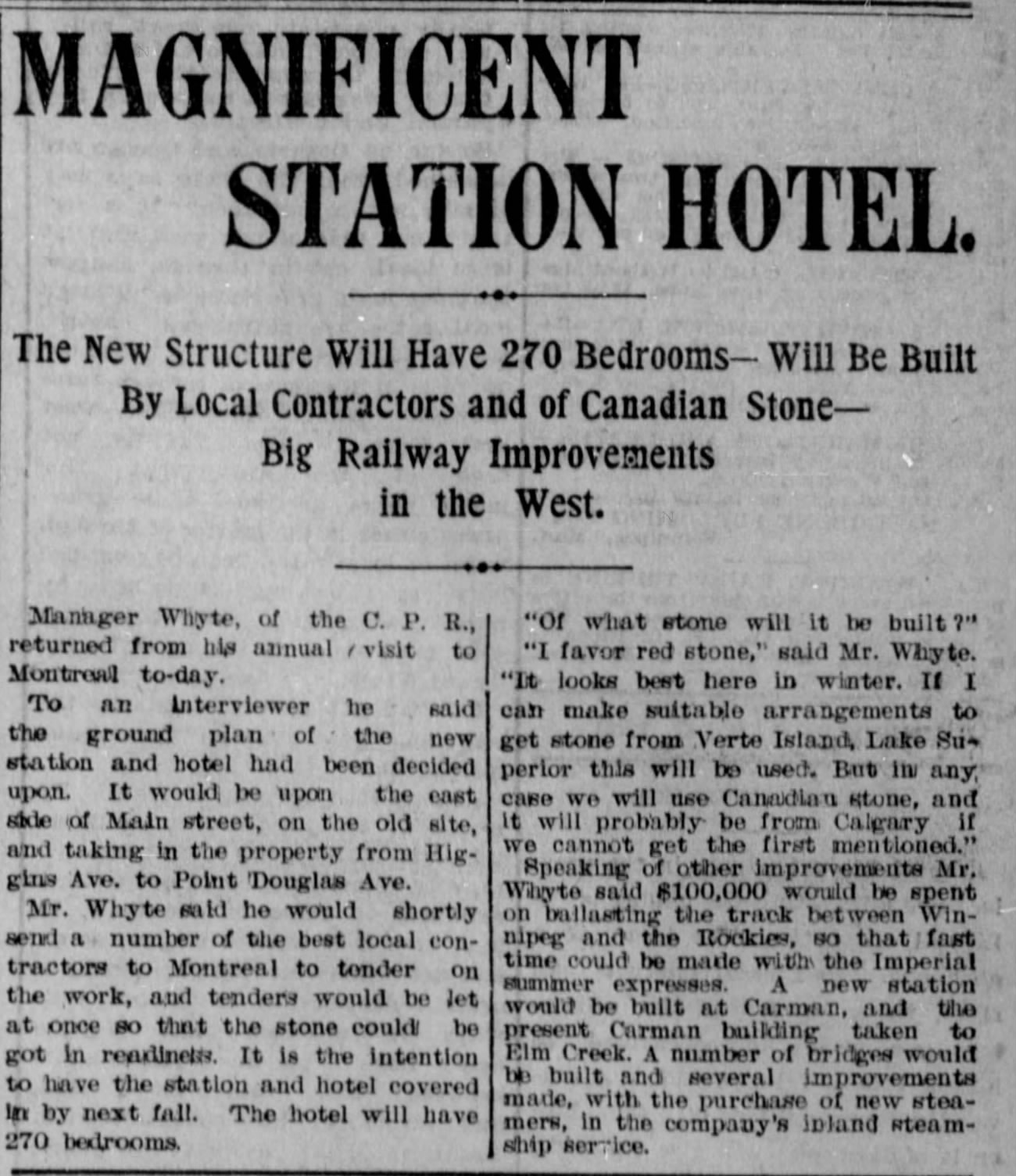
Reports plans for a large hotel at Main and Higgins and Whyte's preference for Canadian building stone. Not evidence of completion on this date.
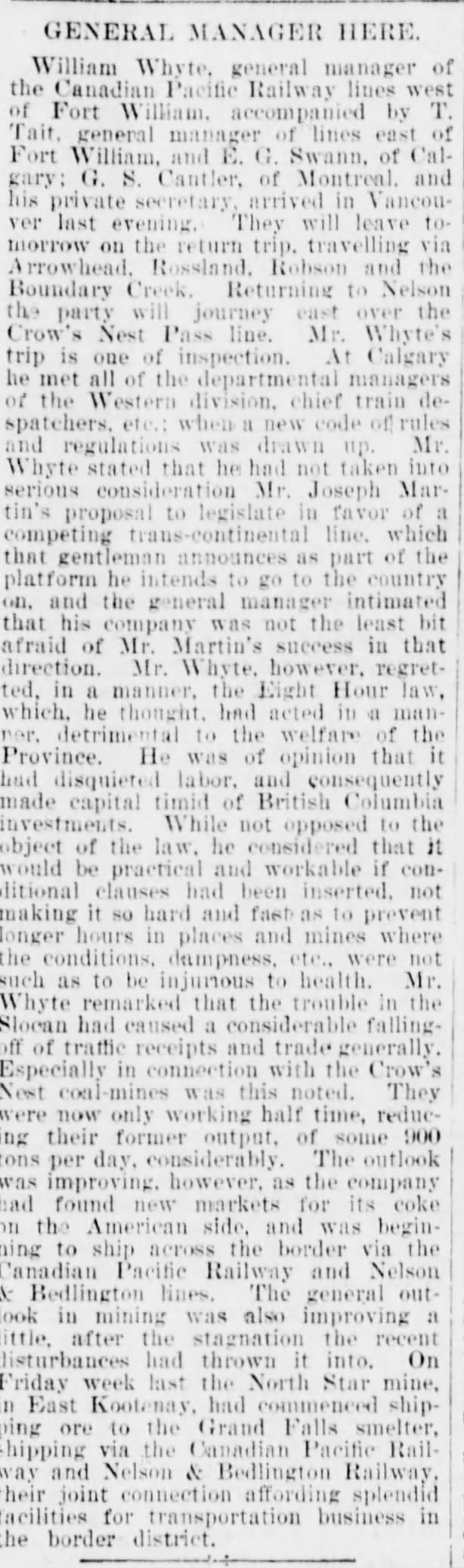
Whyte discusses railway affairs and criticizes the effects of British Columbia's eight-hour legislation on investment and work arrangements.
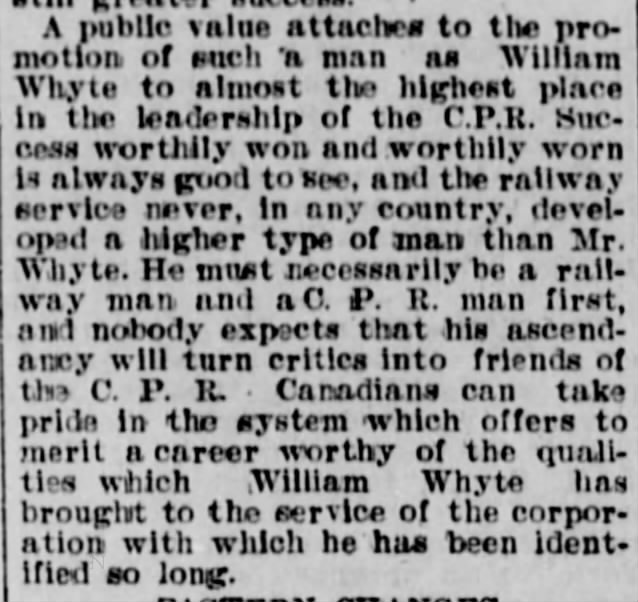
An editorial praises Whyte's promotion while maintaining that admiration for him does not prevent criticism of the CPR.
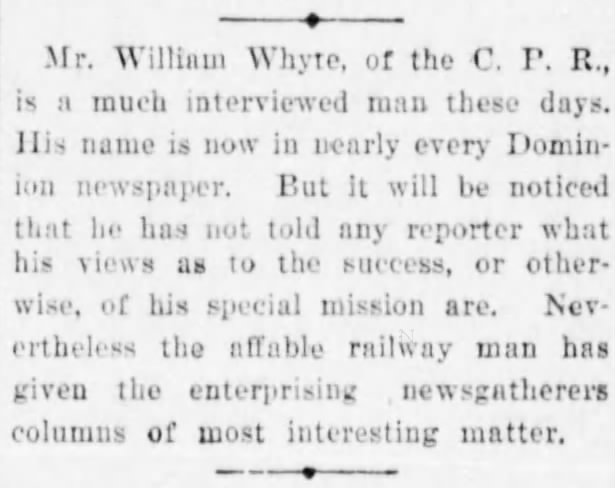
A short commentary describes reporters' interest in his special mission, but provides no firm account of its outcome.
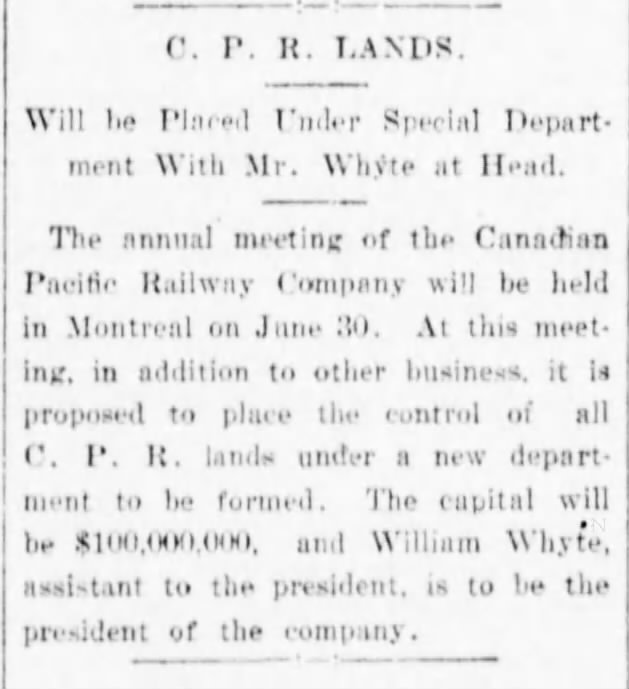
Reports a proposal for a separate land company under Whyte. This clipping does not establish that the scheme was carried out.
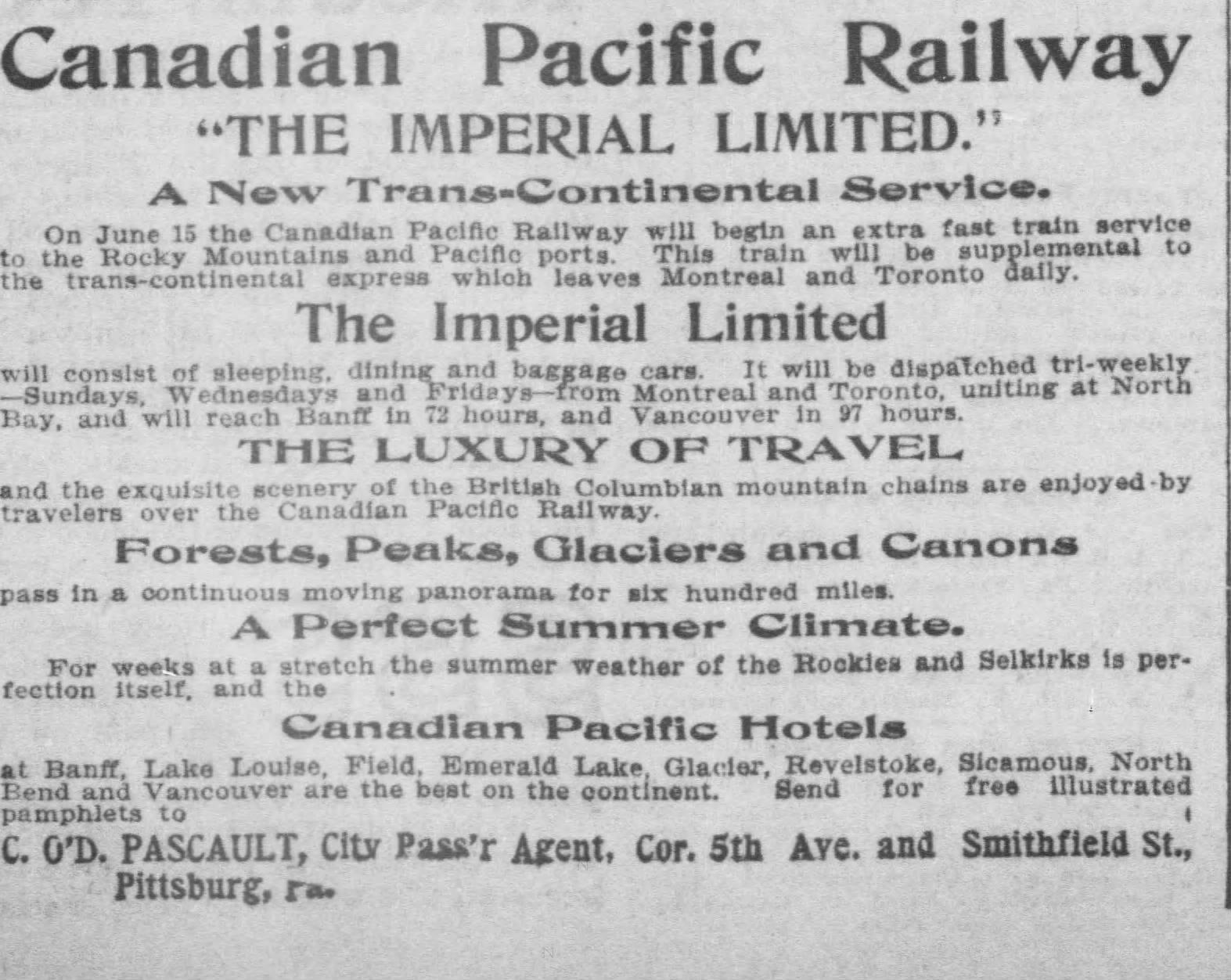
A CPR travel advertisement promotes the railway and mountain destinations. It supplies period context, not direct evidence about Whyte.
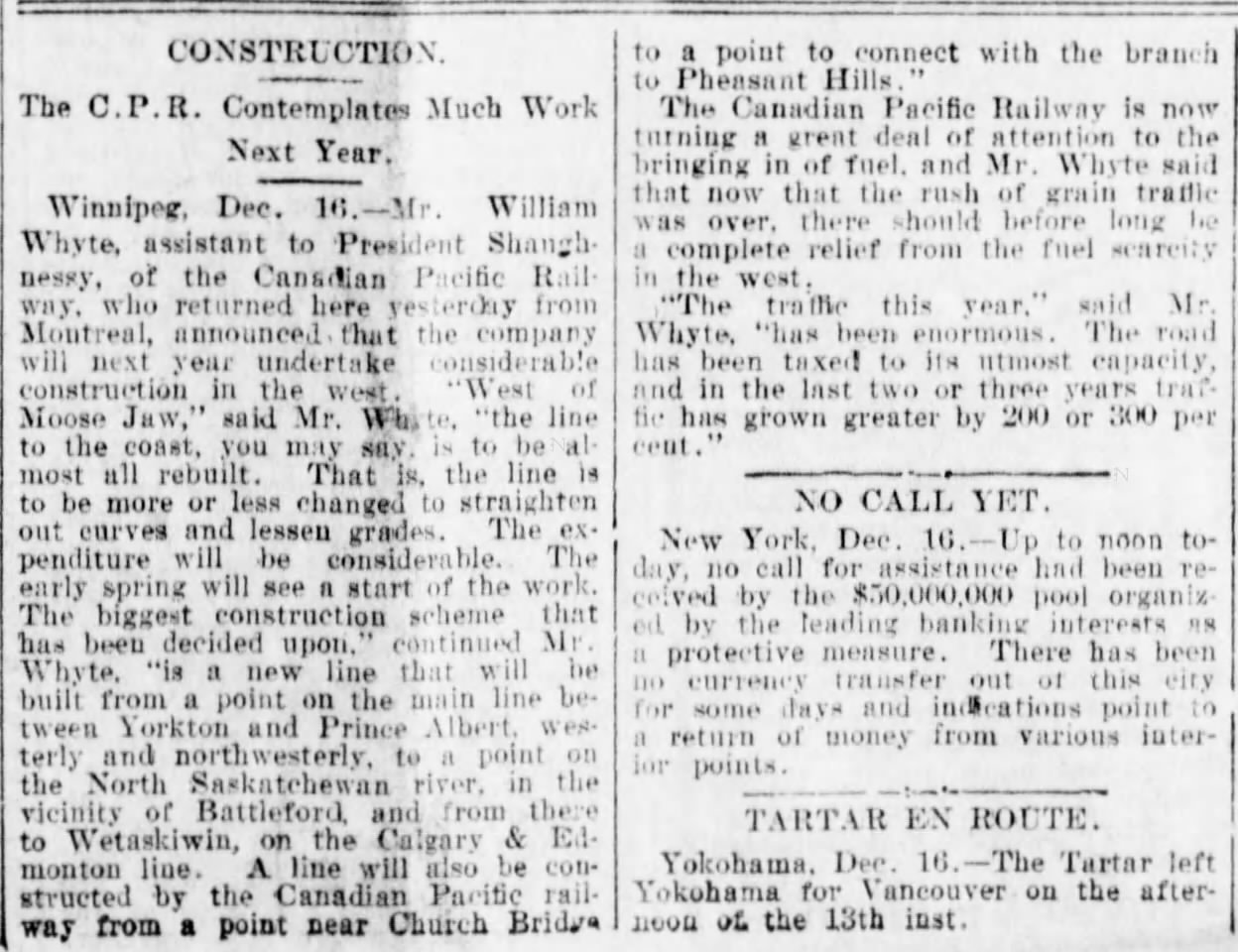
Reports proposed track improvements and branches, alongside the pressure of growing traffic and a shortage of fuel.
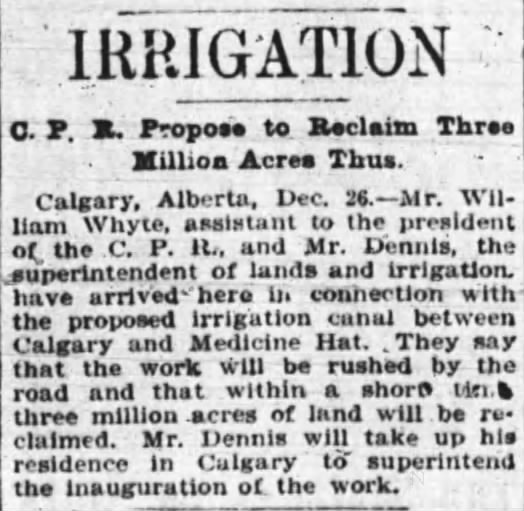
Whyte and J. S. Dennis discuss irrigation around Calgary and toward Medicine Hat. Projected acreage is a proposal, not a completed result.
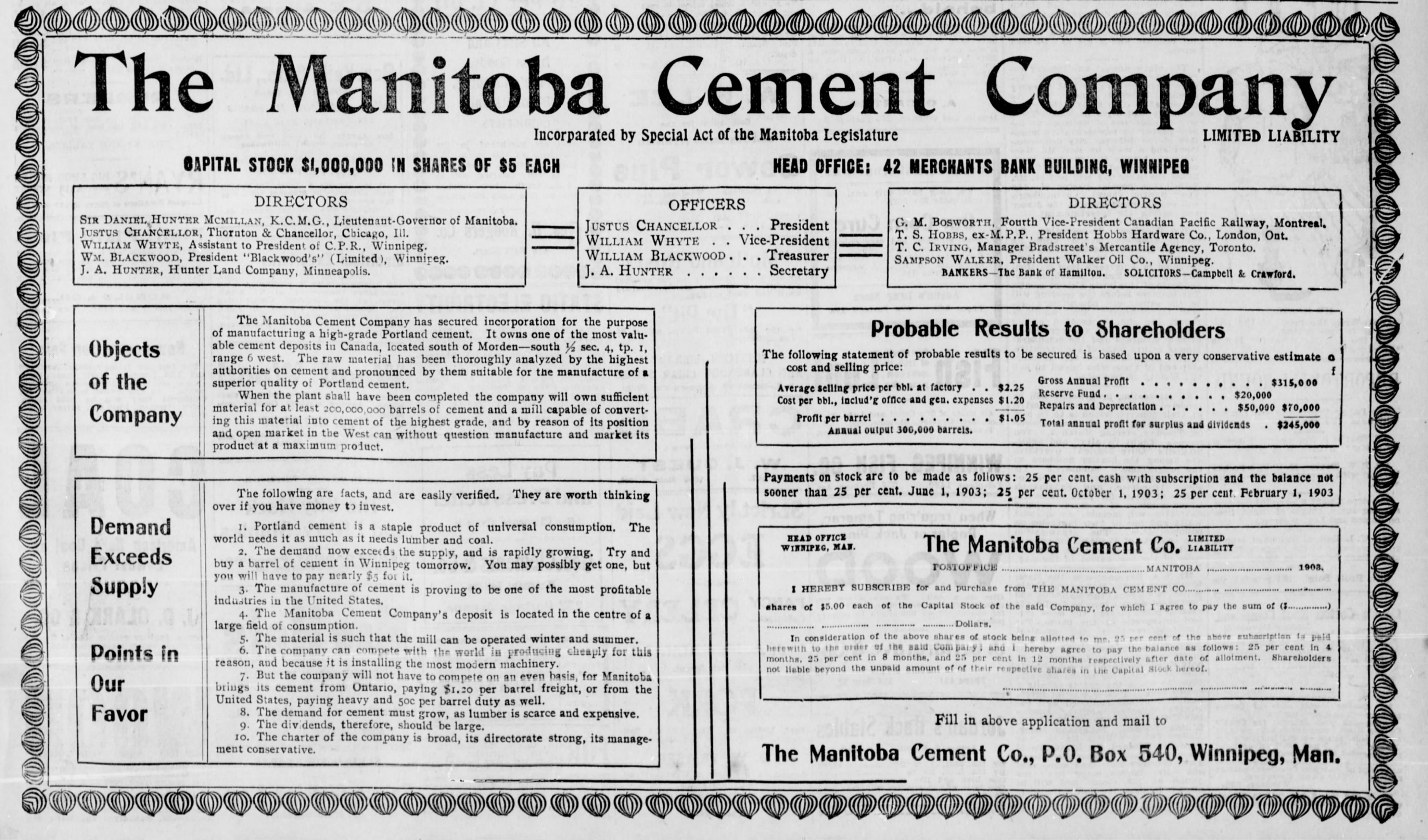
An advertisement lists Whyte as vice-president of the Manitoba Cement Company. Promotional claims should be read as advertising.
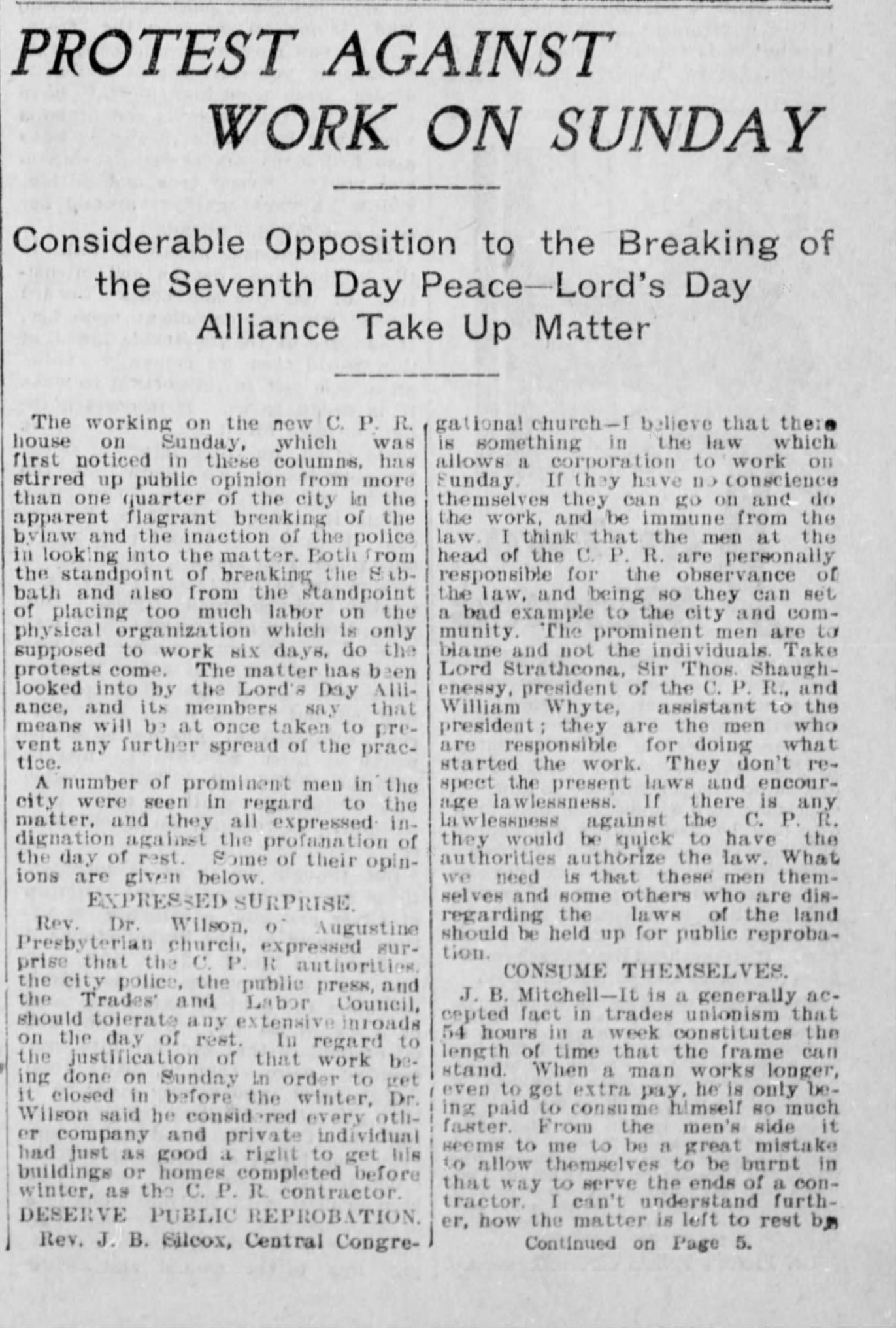
Ministers associated with the Lord's Day Alliance name railway executives in a protest over Sunday construction. The report records allegations, not legal findings.
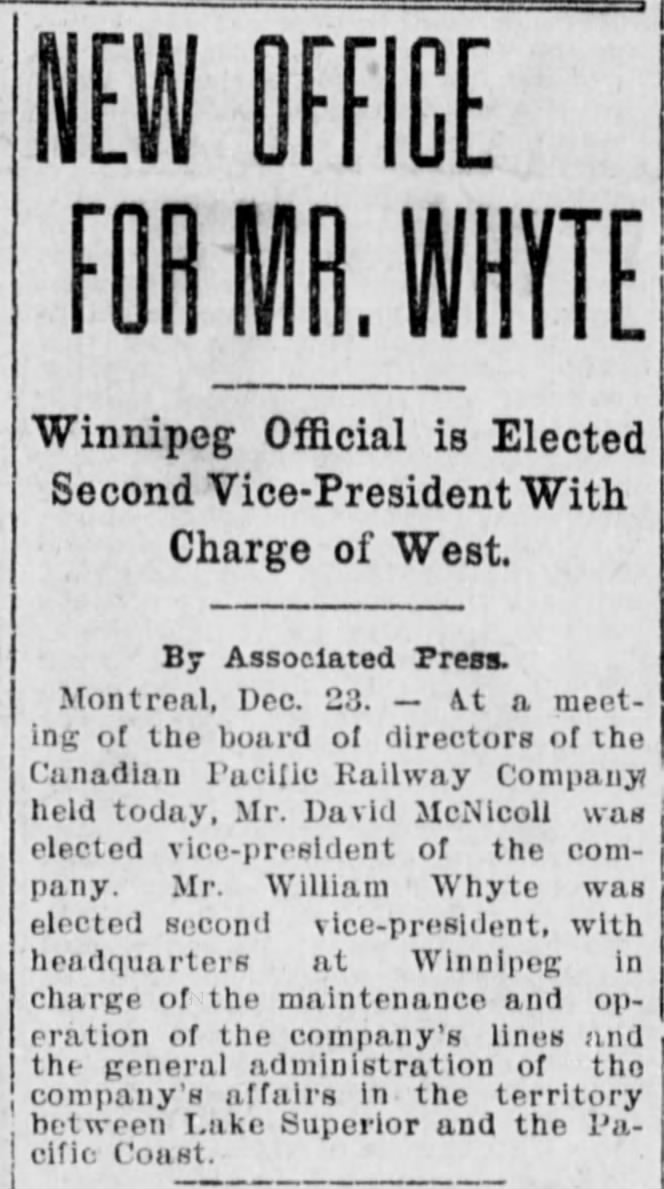
Reports the board's election of Whyte as second vice-president on December 23, 1903. Later accounts give January 1, 1904 as the effective date.
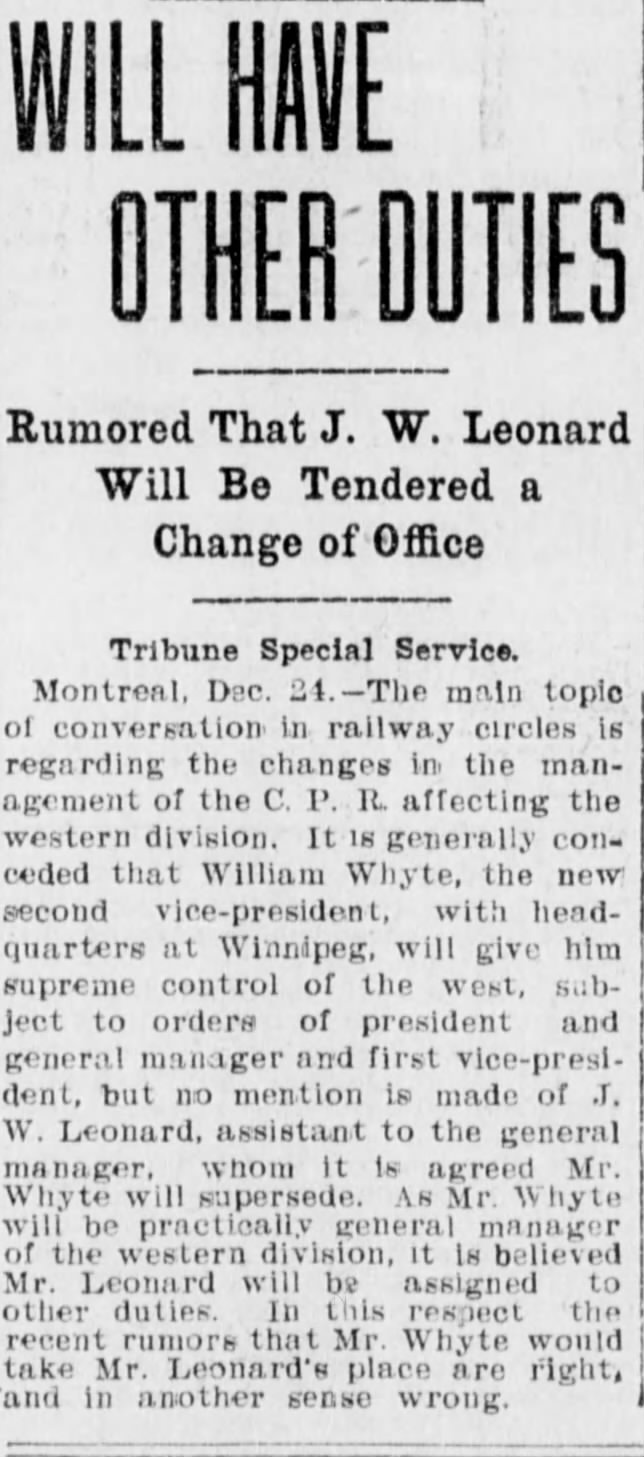
Discusses possible changes in responsibilities following Whyte's new appointment. Some of the personnel changes are still speculative.
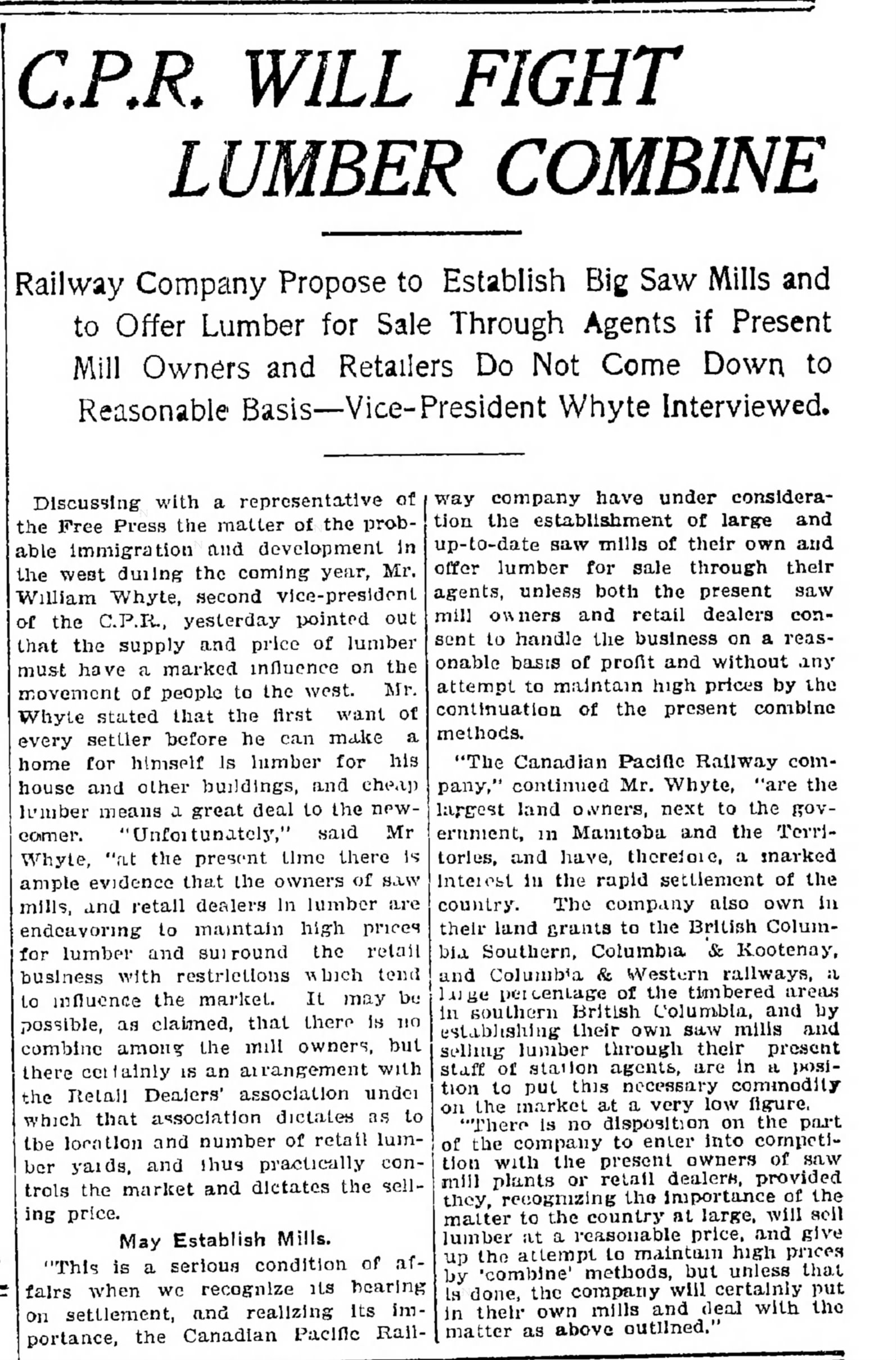
Whyte threatens CPR competition with lumber suppliers if prices remain too high. Affordable homes for settlers and the railway's commercial interests both feature.
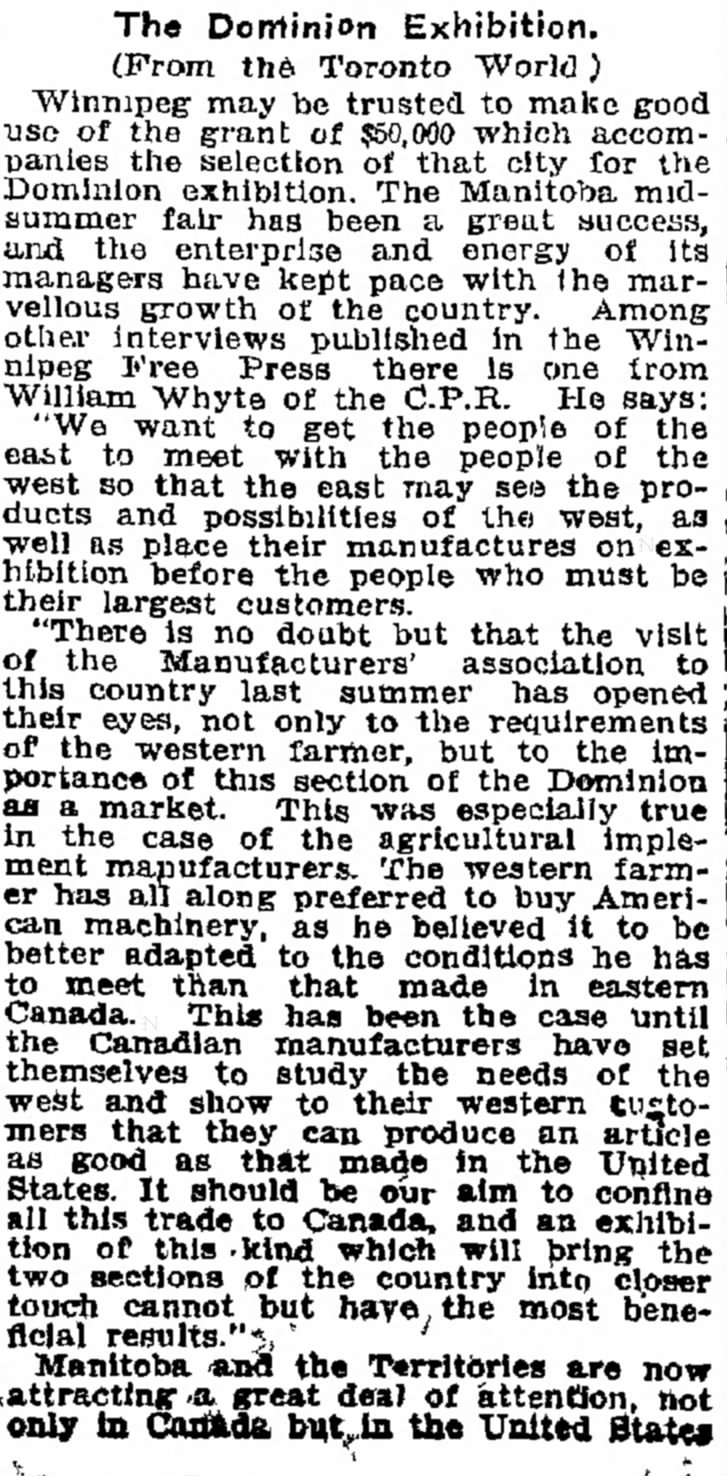
A discussion of the Dominion Exhibition quotes Whyte on the connection between eastern manufacturing and western agriculture.
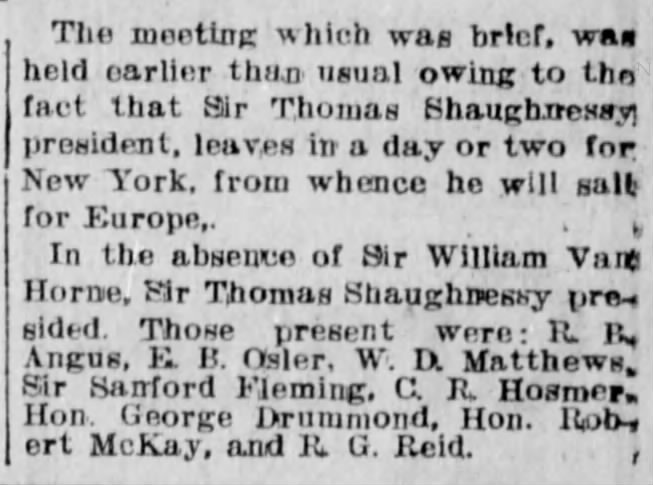
Brief attendance report: Shaughnessy presides and Van Horne is absent. It does not establish anything about the 1899 presidential vote.
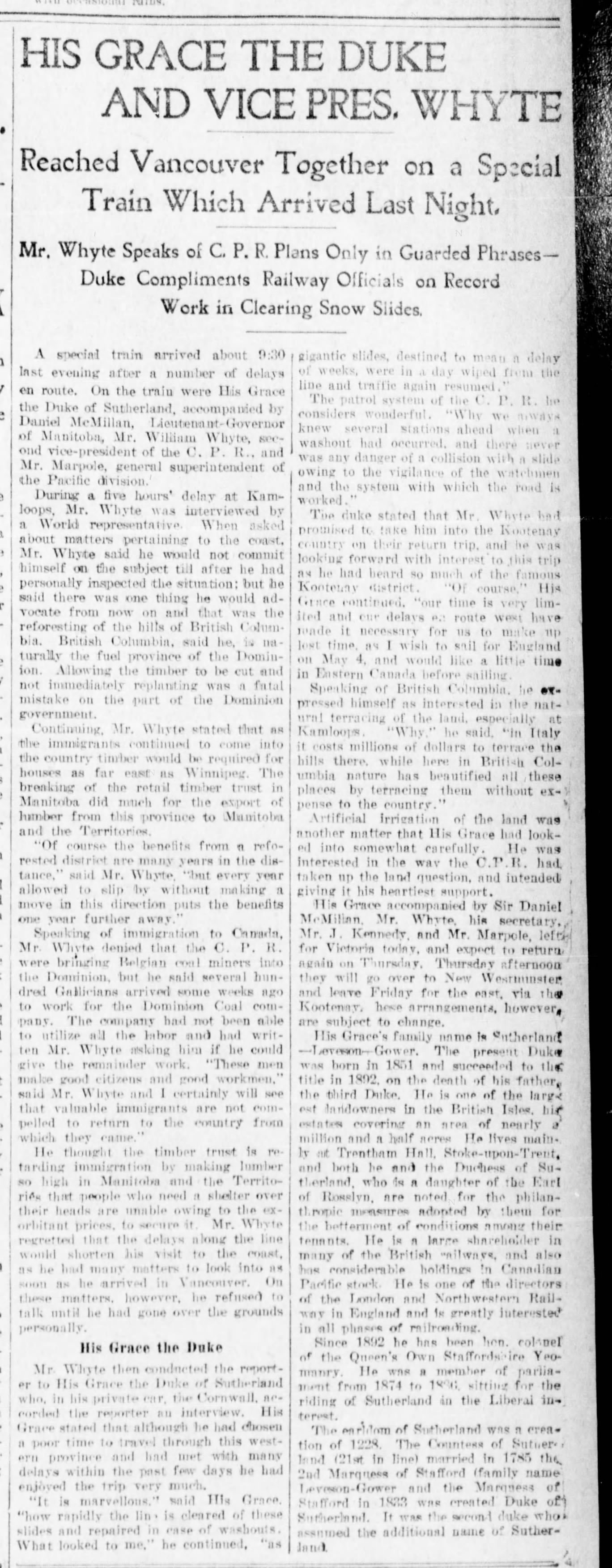
During an inspection trip with the Duke of Sutherland, Whyte argues for replacing trees that are cut. The report places his reforestation advocacy in 1904.

A tourism feature on the Sicamous and Mara Lake area. No direct connection to Whyte was established in the extracted text.
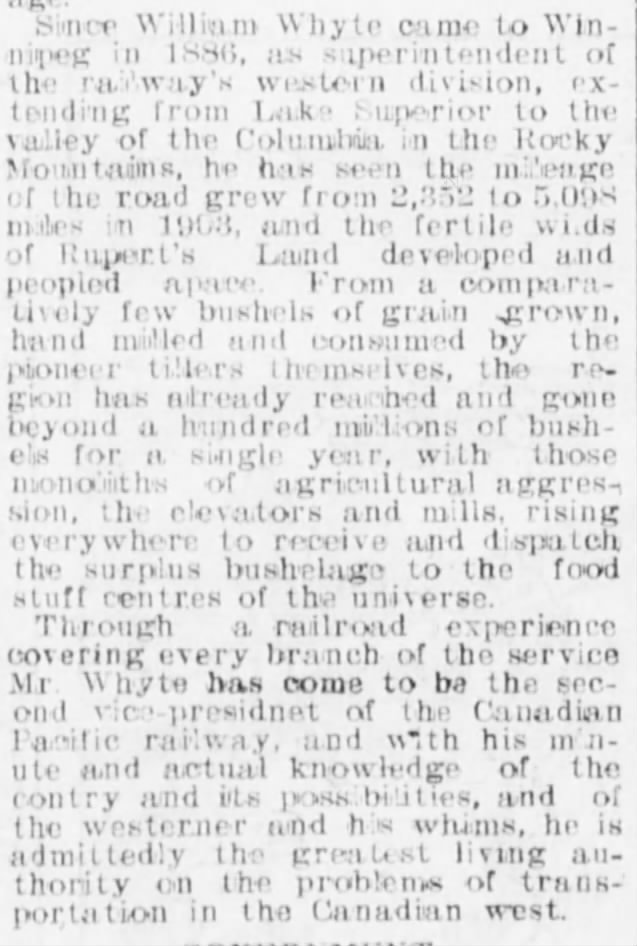
Reviews expanding railway mileage and grain traffic and Whyte's standing as a transportation manager.
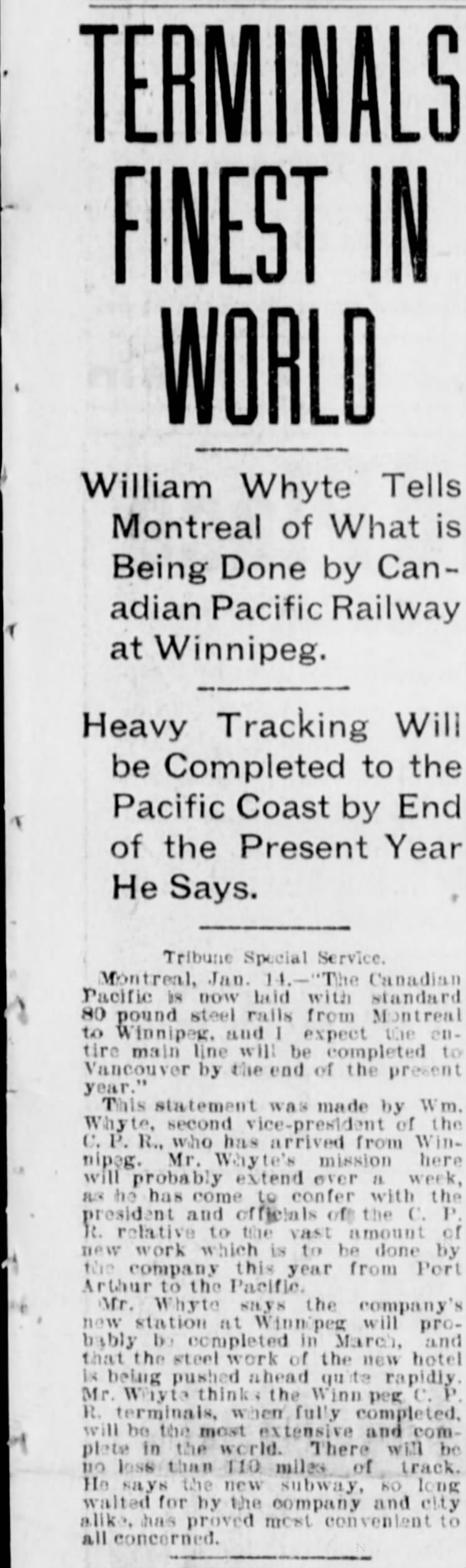
Describes ambitious station and terminal improvements and heavier railway track. The article concerns plans and work in progress.
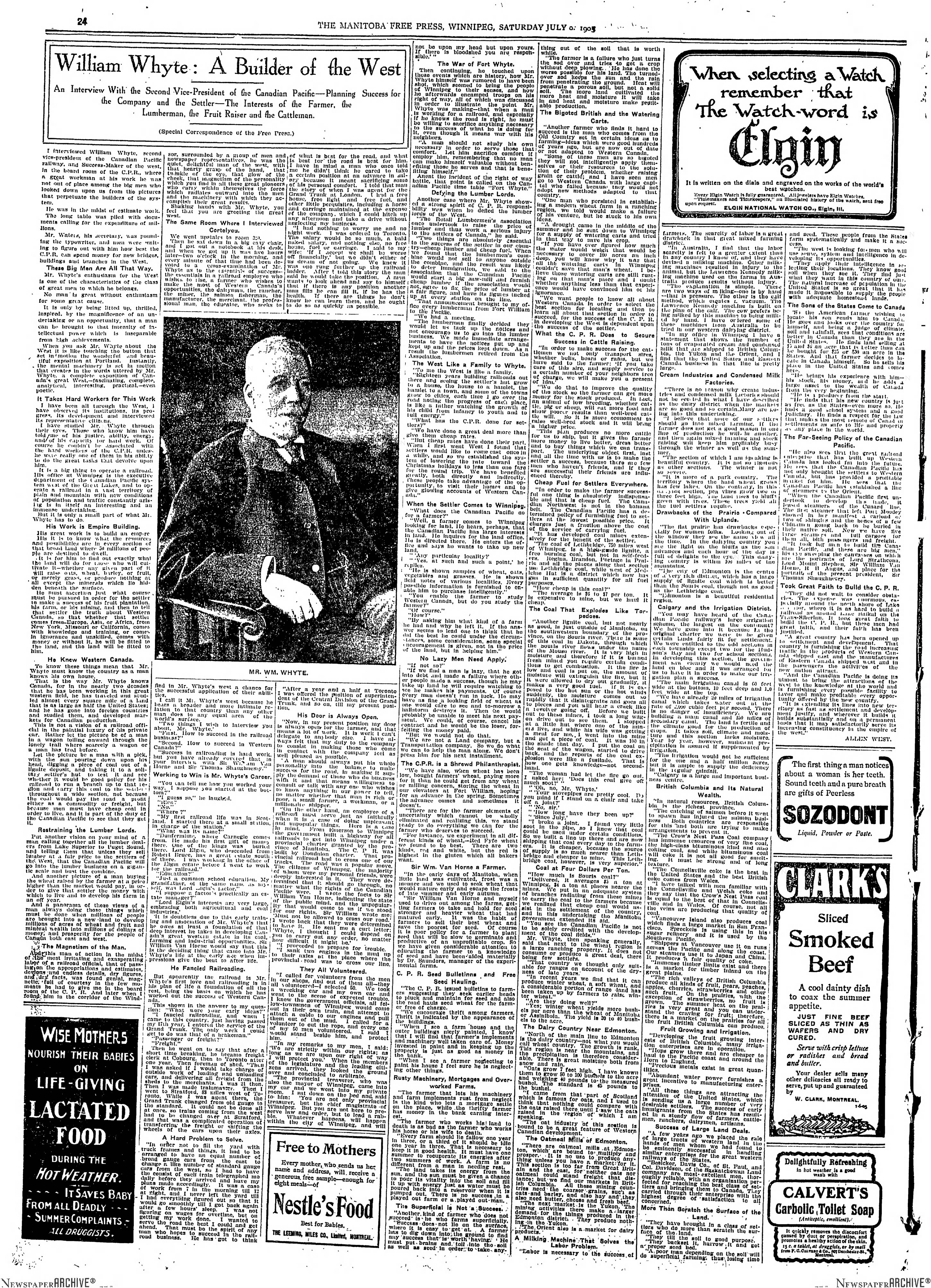
A second saved clipping from the same July 8, 1905 page. Its extracted text matches the other copy; it is not independent corroboration.
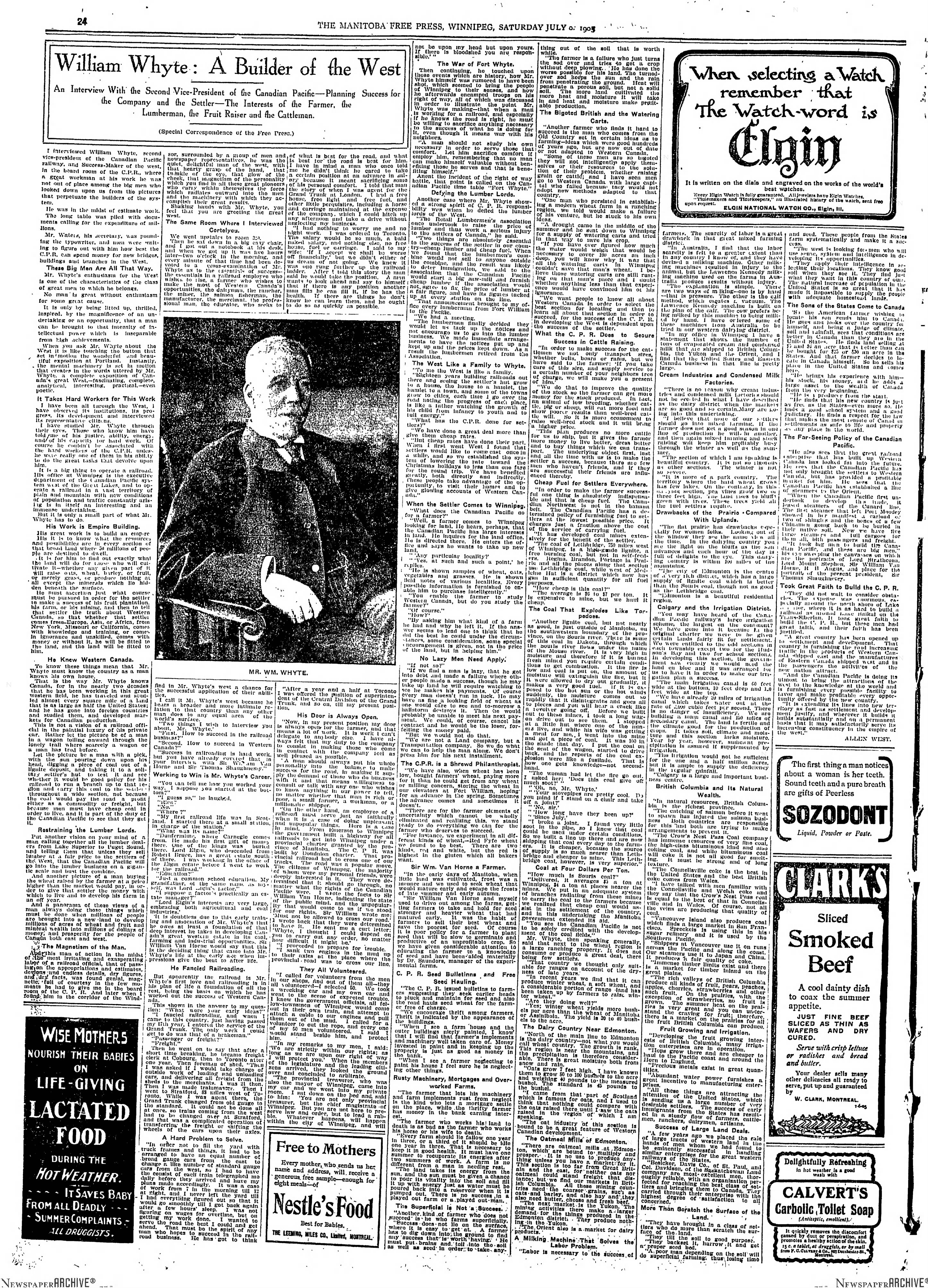
Allen West's long profile and interview covers Whyte's career, Fort Whyte, settlers' fuel and lumber, farming and livestock. An important account of his own outlook, also shaped by railway promotion.
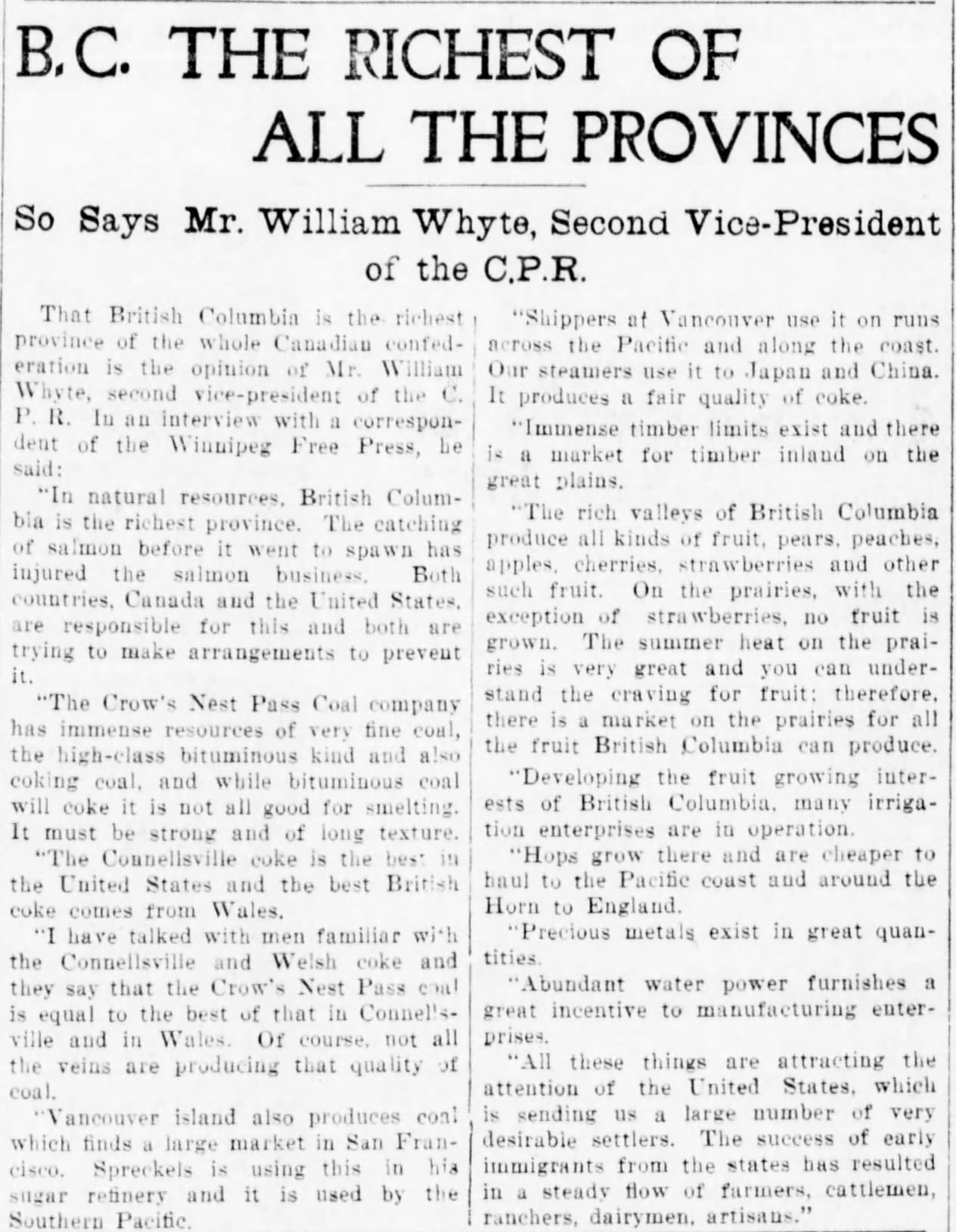
An extract from the 1905 interview discusses British Columbia's resources, irrigation and the protection of salmon spawning. Another lead into his views on conservation.
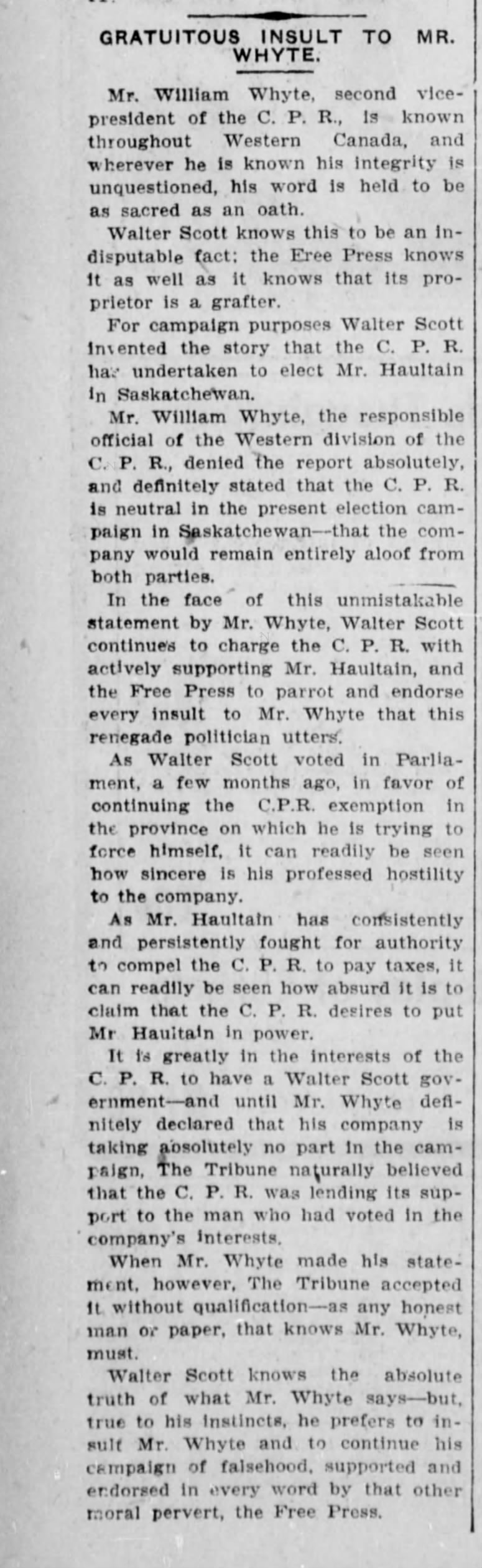
A strongly partisan editorial defends Whyte during the Saskatchewan election controversy. Its claims about political neutrality need independent checking.
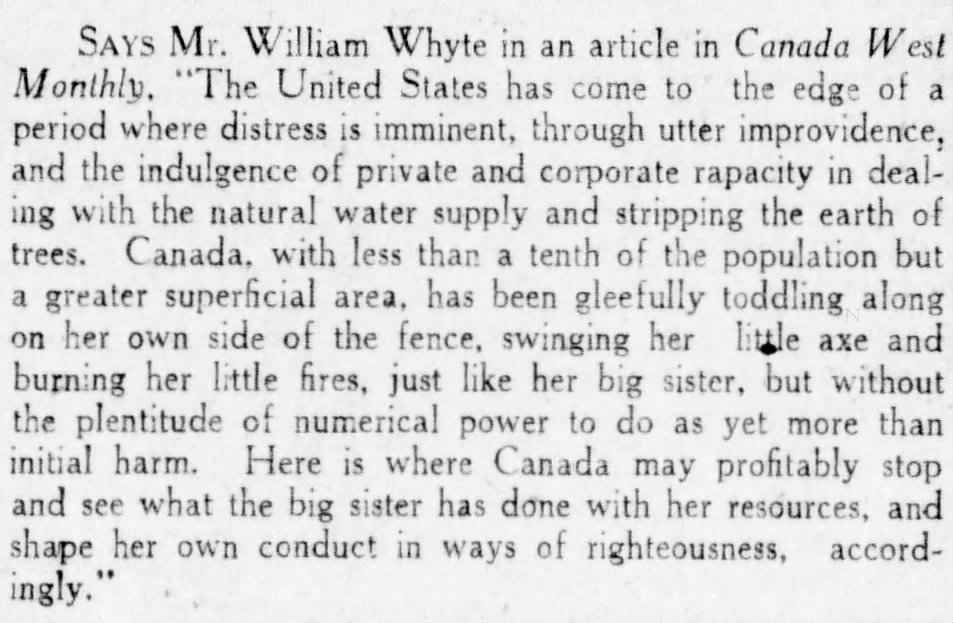
Quotes Whyte's argument against wasting forests and water. This July 1909 notice places his Canada West essay in circulation by that date.
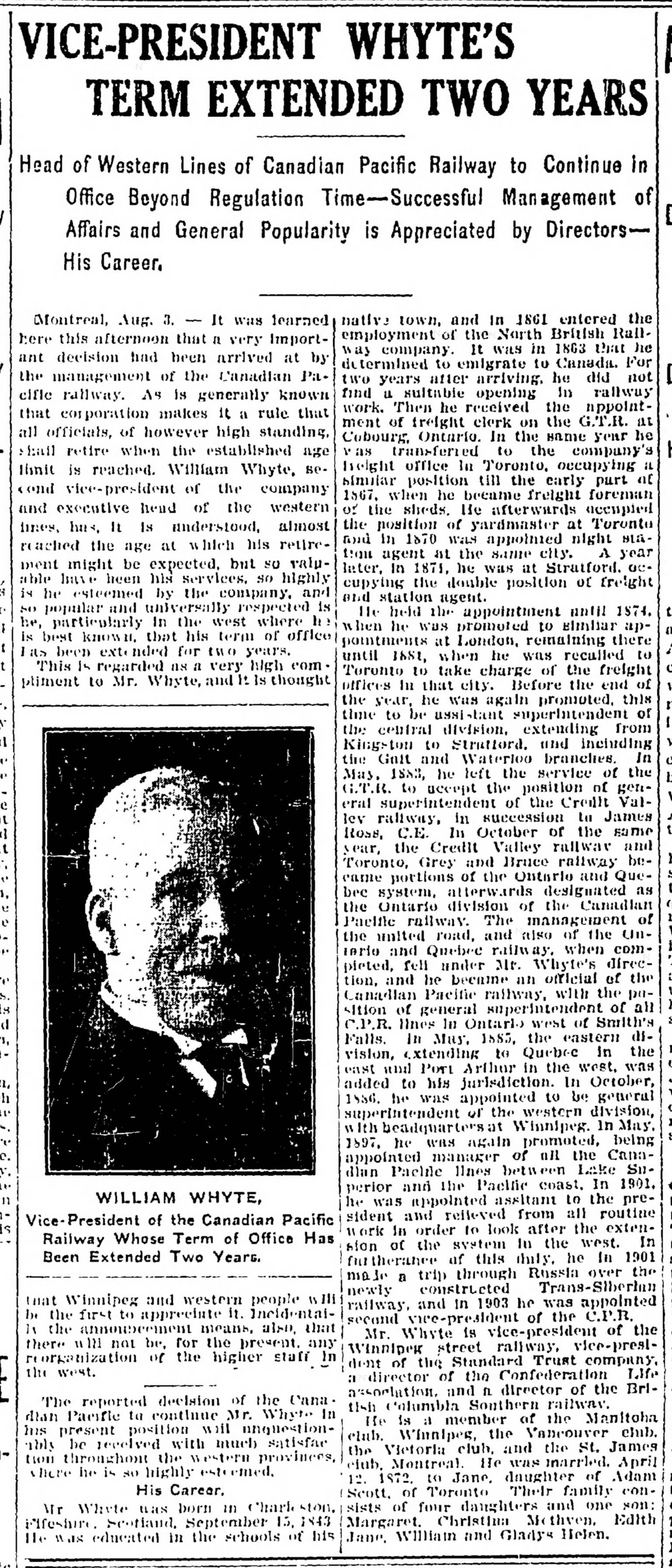
Reports the extension of his service beyond the normal retirement age and recalls his 1901 Trans-Siberian journey.
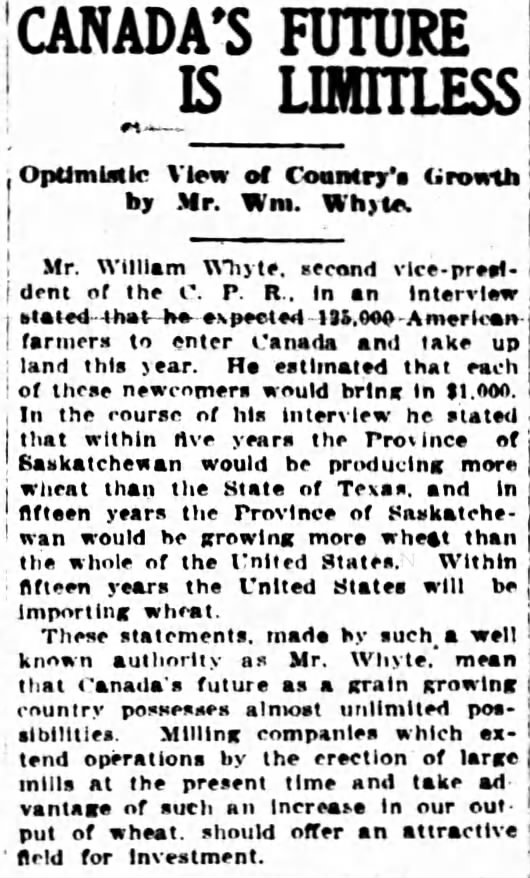
Whyte forecasts expanding immigration and grain production. These are his predictions, not a record of subsequent results.
A tourism advertisement for travel to Banff. Preserved as railway context, not as evidence of an action by Whyte.
Reports the arrival of congratulations following the announcement of his knighthood in 1911.
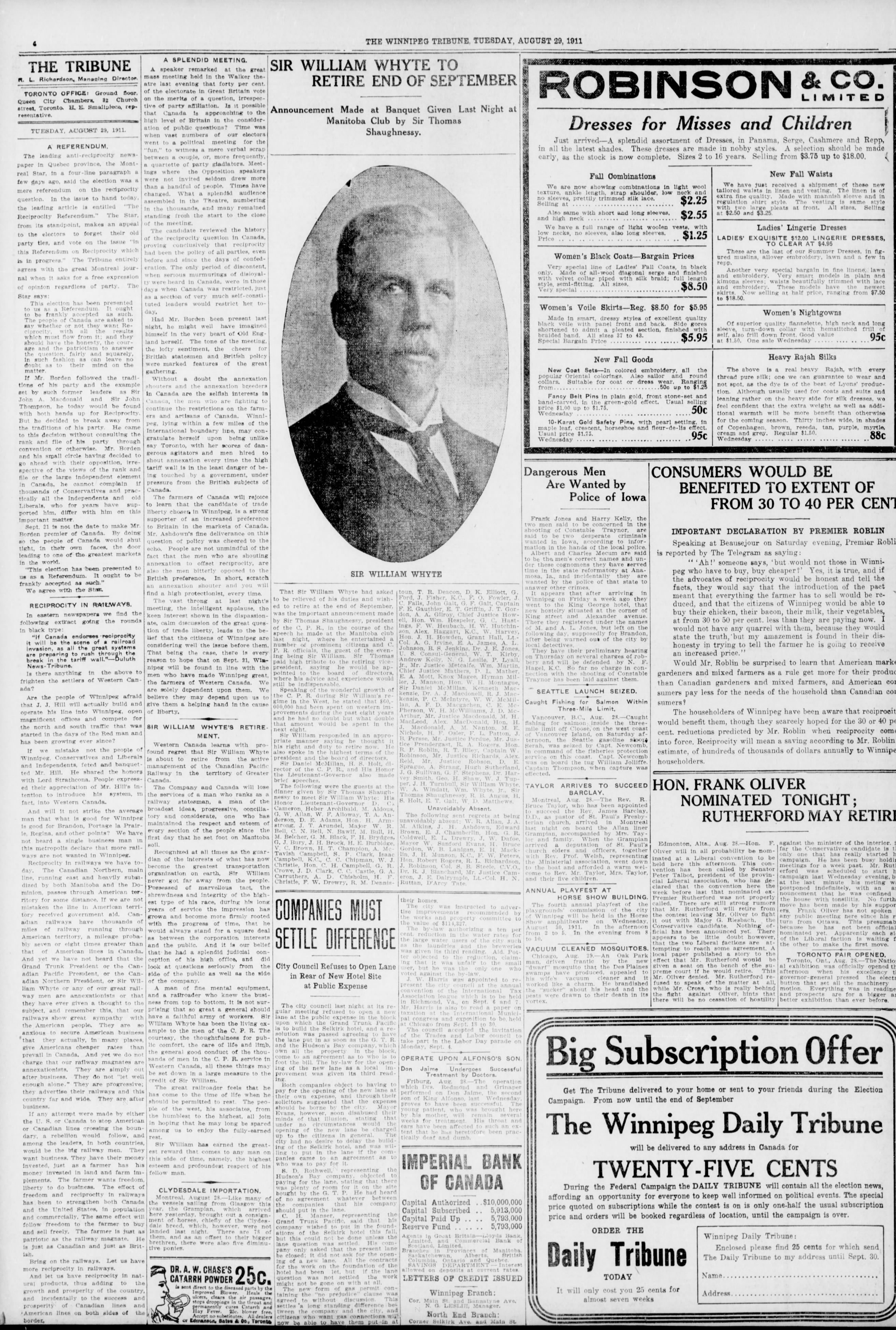
A Winnipeg editorial and account of retirement honours. The saved page also contains unrelated news and advertisements.
Reports Whyte's forthcoming retirement and Shaughnessy's tribute at a dinner. Retirement from executive work did not end his connection with the board.
A retirement editorial praises Whyte and discusses a possible future high-commissioner role. This was speculation, not an appointment.
Reports arrangements for a banquet at the Royal Alexandra and a presentation to the retiring railwayman.
Describes a presentation of silver and tributes from railway colleagues, including George Bury and F. W. Peters.
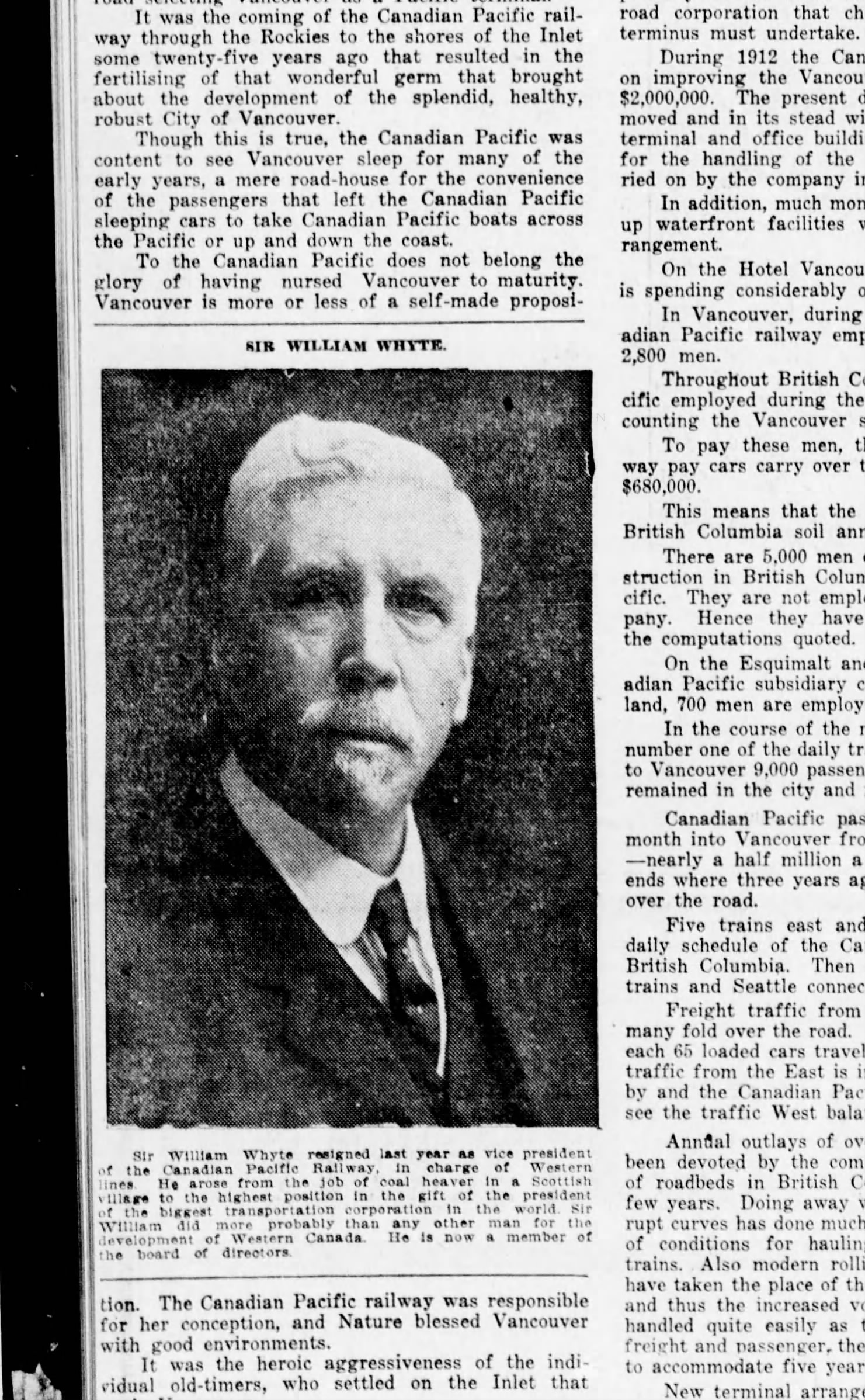
A feature on Vancouver's development includes Whyte's portrait. It places him within a wider story involving the railway and other developers.
Another saved clipping from the same April 15, 1914 page. Its extracted text matches the other Peters tribute; it is not a second independent account.
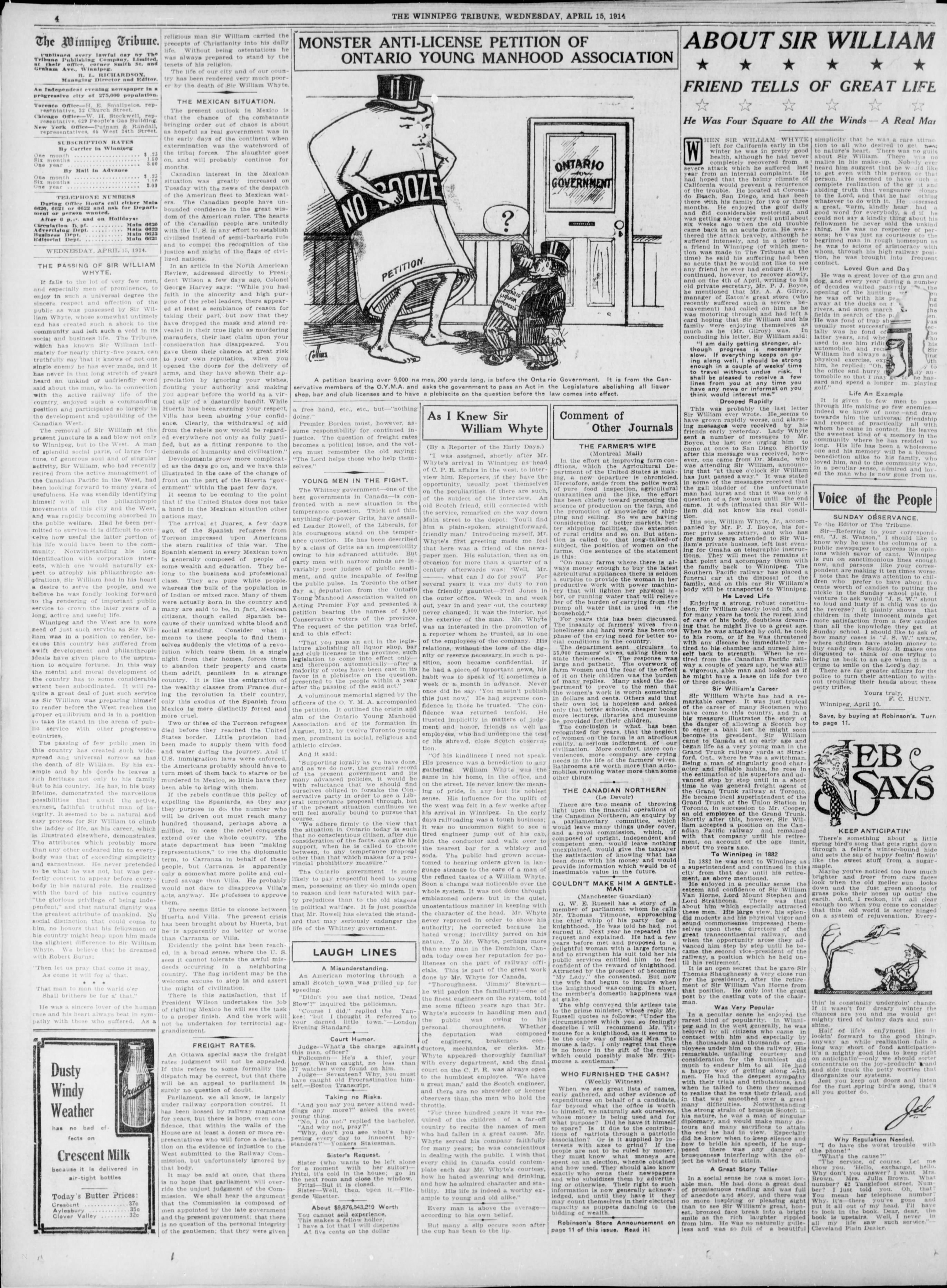
An obituary page includes the claim that Whyte lost the presidency through the chairman's casting vote. Published in 1914, fifteen years after the succession; board confirmation is still needed.
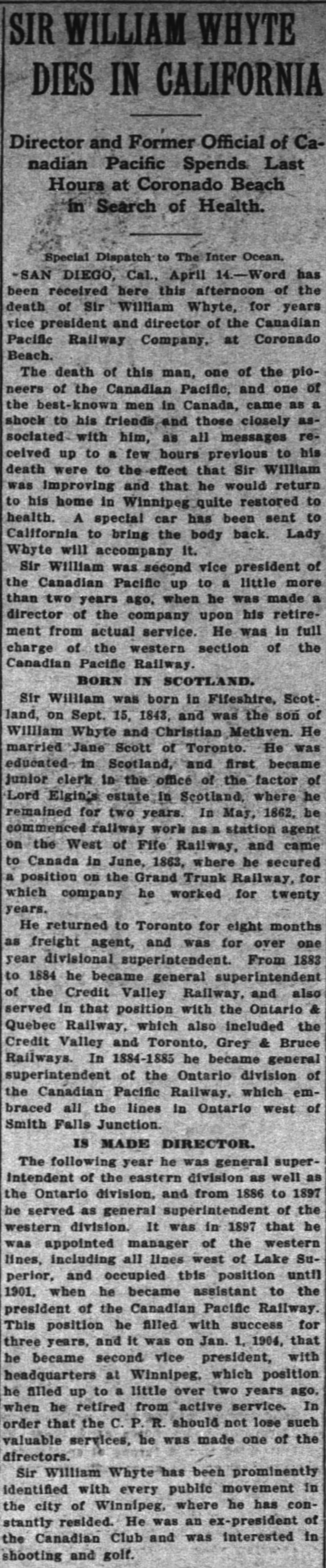
A short report on Whyte's death in California and railway career. Gives January 1, 1904 as the effective date of his second vice-presidency.
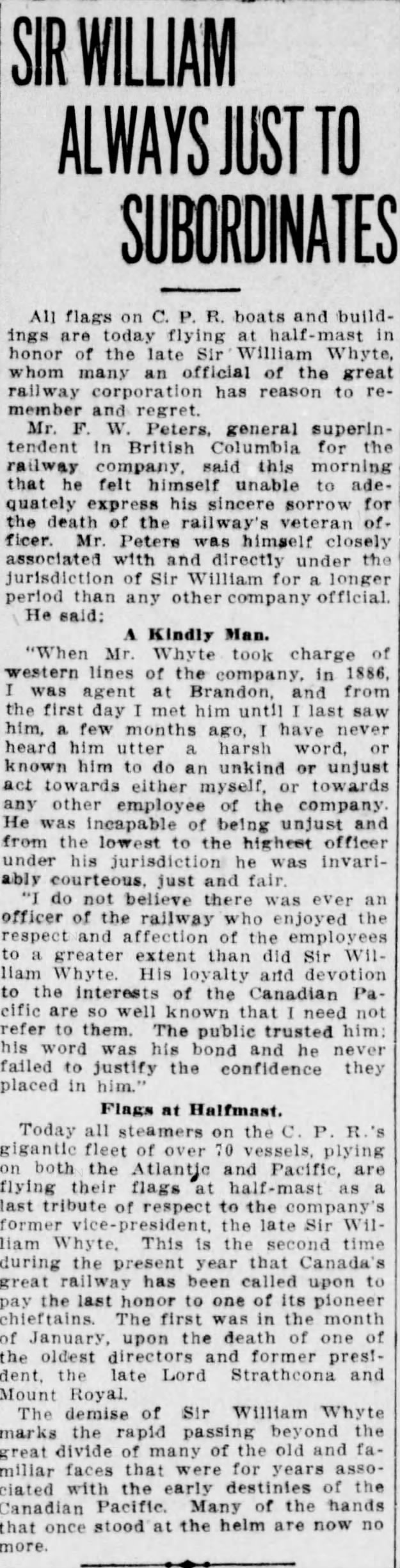
Reports flags at half-mast across the CPR fleet of more than 70 vessels on the Atlantic and Pacific, as well as boats and buildings. F. W. Peters recalls the affection of employees and the public trust Whyte earned.
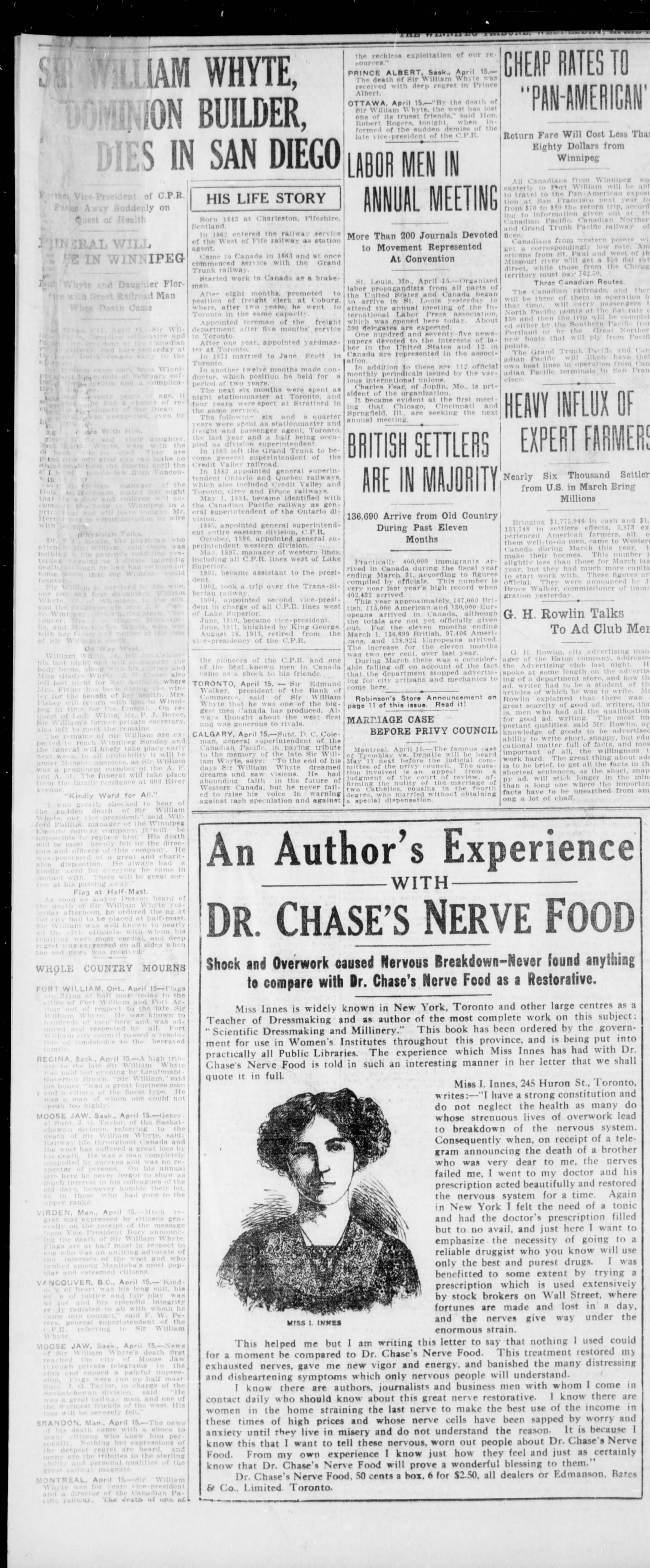
An extensive obituary and career chronology, including the Trans-Siberian journey. The extracted text is badly interleaved; details require checking against the scan.

The minister recalls a long friendship and correspondence during Whyte's illness. The report also follows the Hunter family's return for the funeral.
Reprints assessments from Regina and Moose Jaw newspapers. Useful evidence of his reputation at the time of his death.

Collects tributes from newspapers in Montreal and Toronto. These are reprinted opinions, not separate reporting by the Tribune.
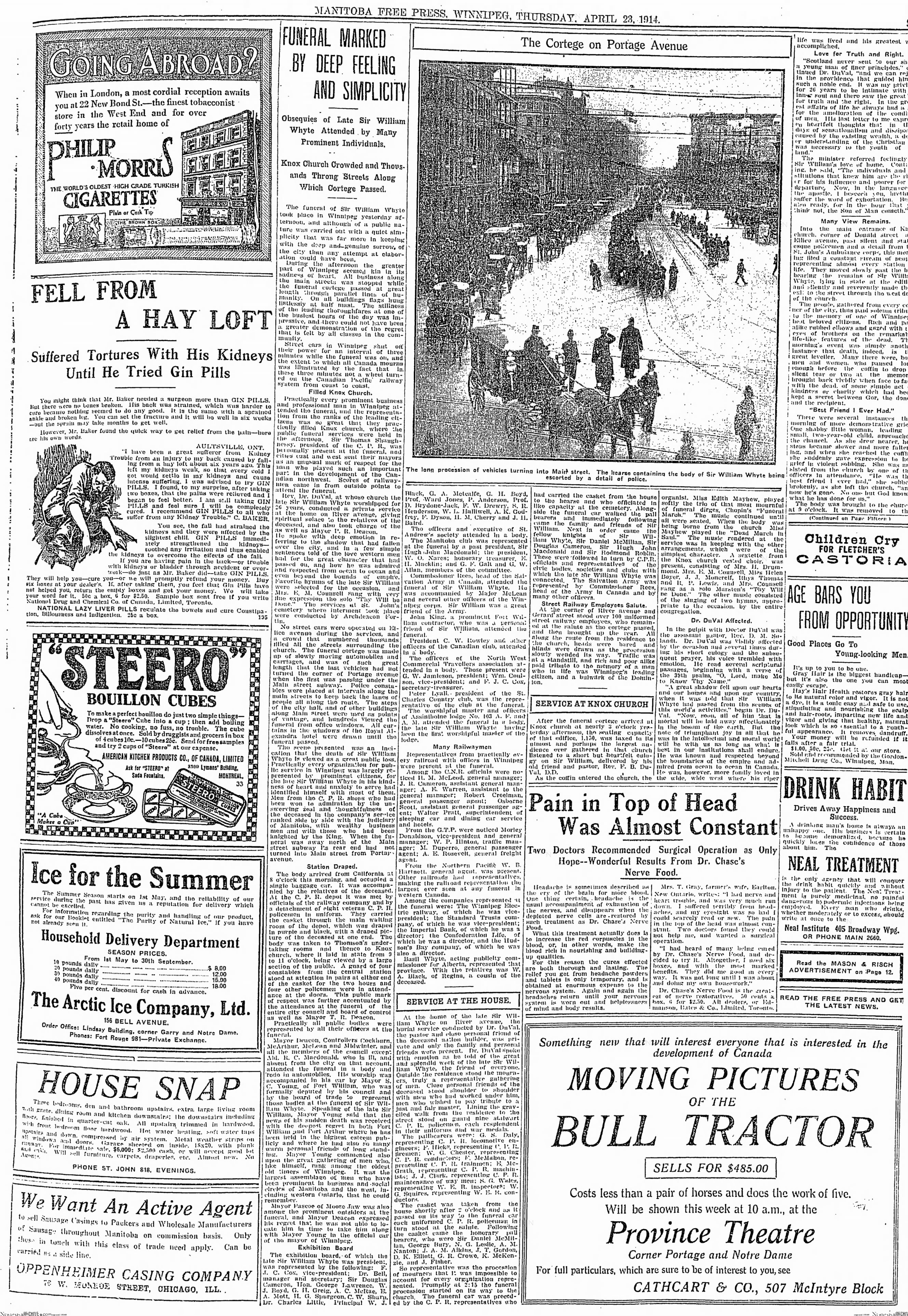
Reports the April 22 funeral at Knox Church, crowds along the route, a three-minute suspension across the entire CPR railway system from coast to coast, and a matching pause by Winnipeg streetcars.
An editorial following the funeral reflects on Whyte's courtesy, character and affection for the poetry of Robert Burns.
Briefly shares credit for Winnipeg's railway growth among Whyte, Van Horne, Strathcona and Hill.
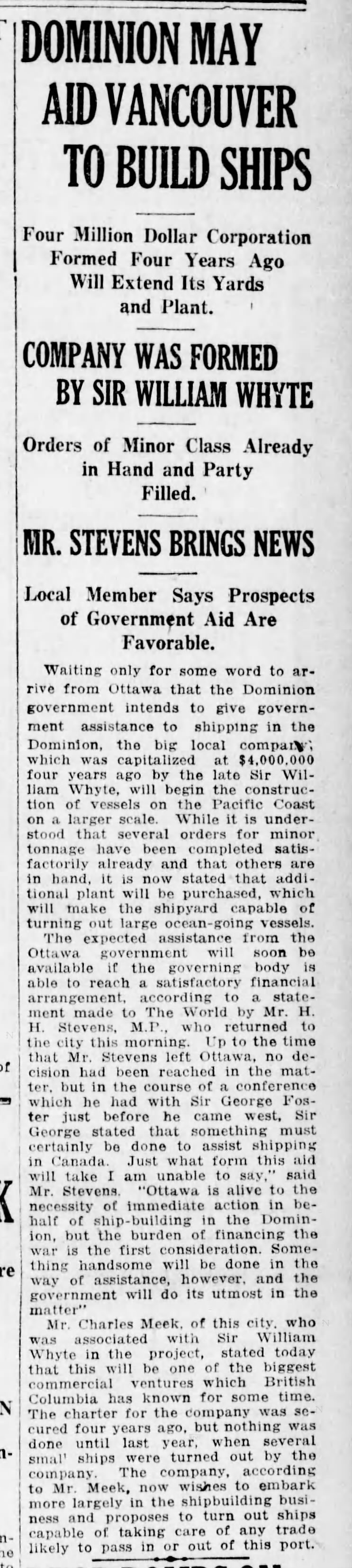
A 1916 report recalls a company formed several years earlier with Whyte's involvement. Reported company capital must not be confused with his personal wealth.
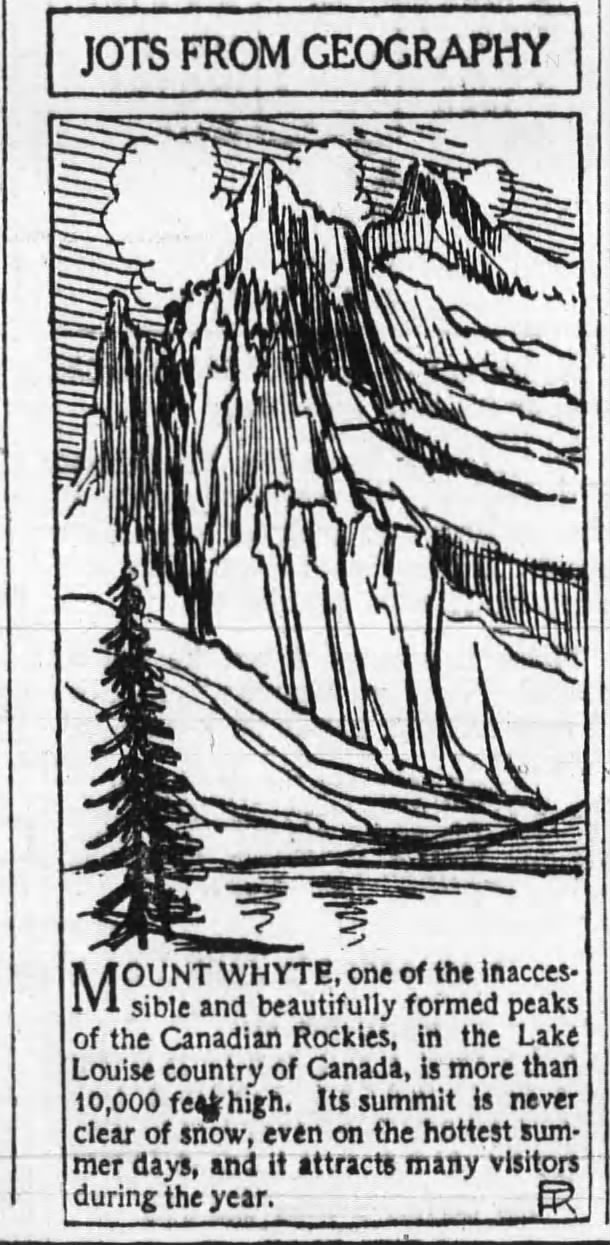
A geographical feature identifies Mount Whyte. Its claim that the peak exceeds 10,000 feet conflicts with Parks Canada's elevation of 2,983 metres.
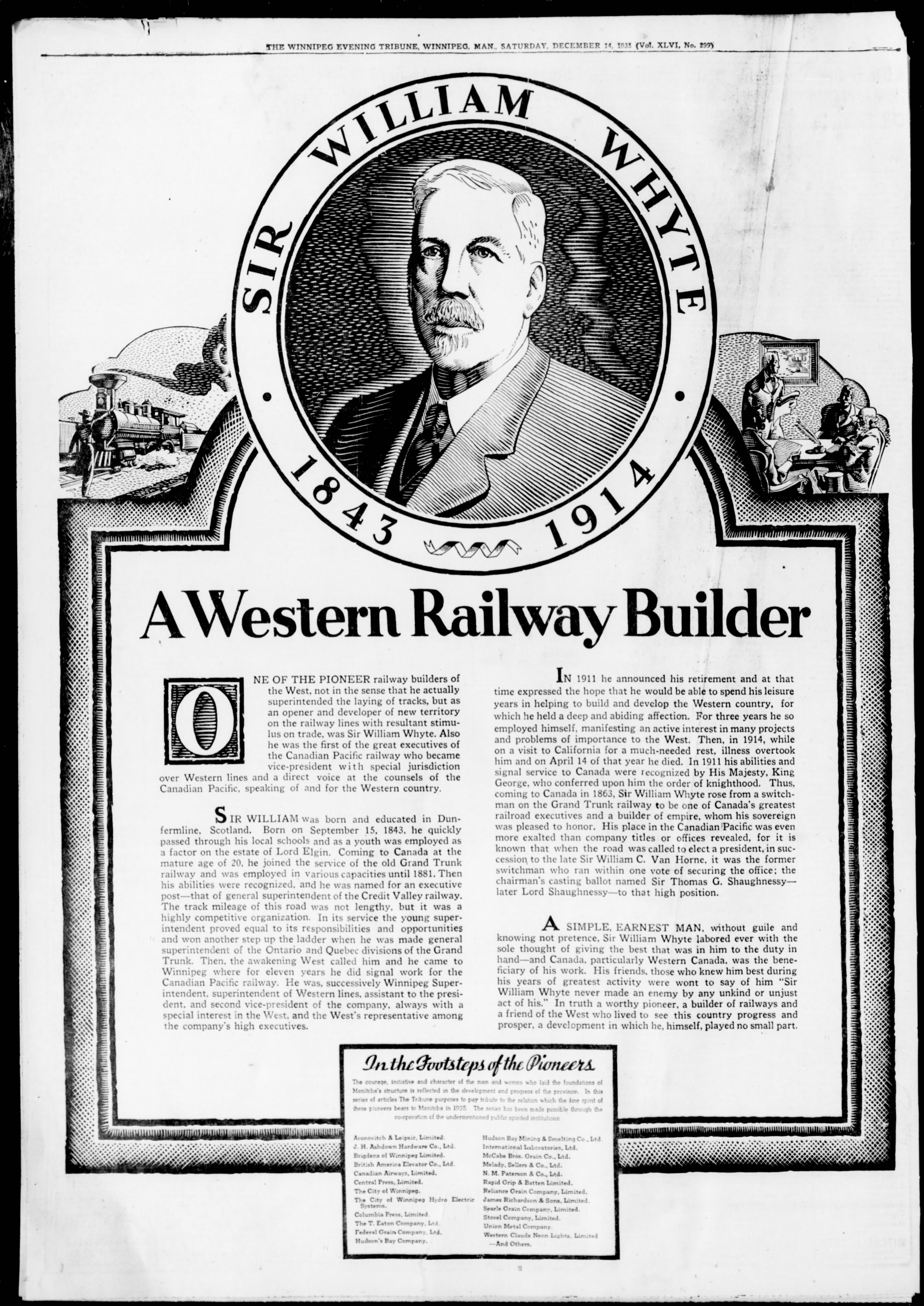
A 1935 retrospective repeats the close presidential contest and deciding vote. Because the 1914 account appeared in the same newspaper, the two may share a source.
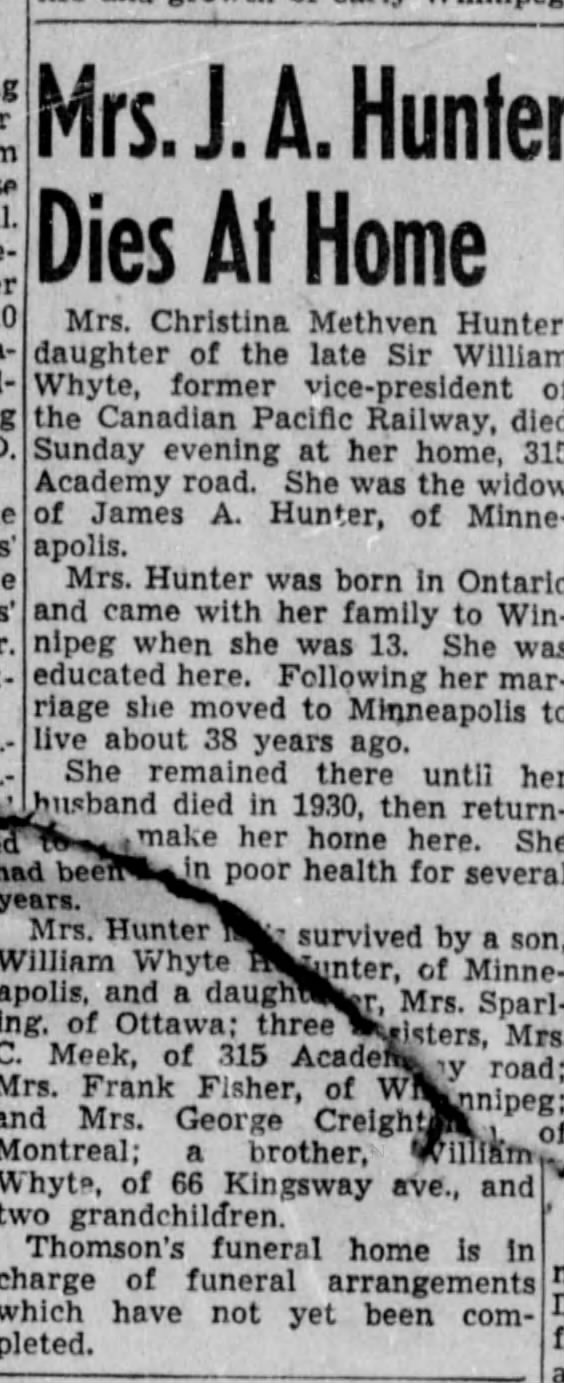
Identifies Christina Methven Hunter as Sir William's daughter and names William Whyte Hunter among her surviving family. The newspaper spelling differs from the family's Christine.
No clippings match this search.