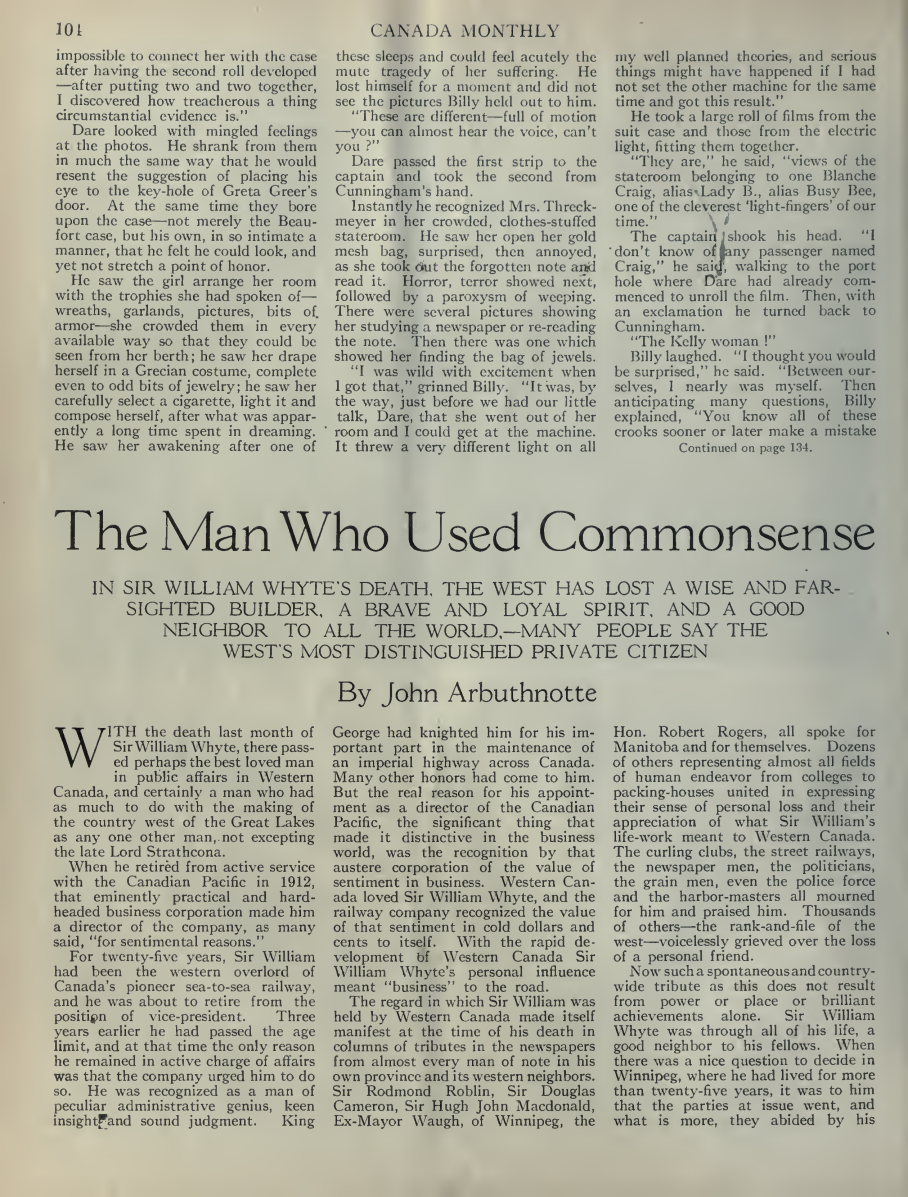
A Canadian historical collection1843 – 1914Preserved by his family

Sir William Whyte

“The West's most distinguished private citizen.”
— Canada Monthly, 1914, reporting the view of “many people”. Page 104

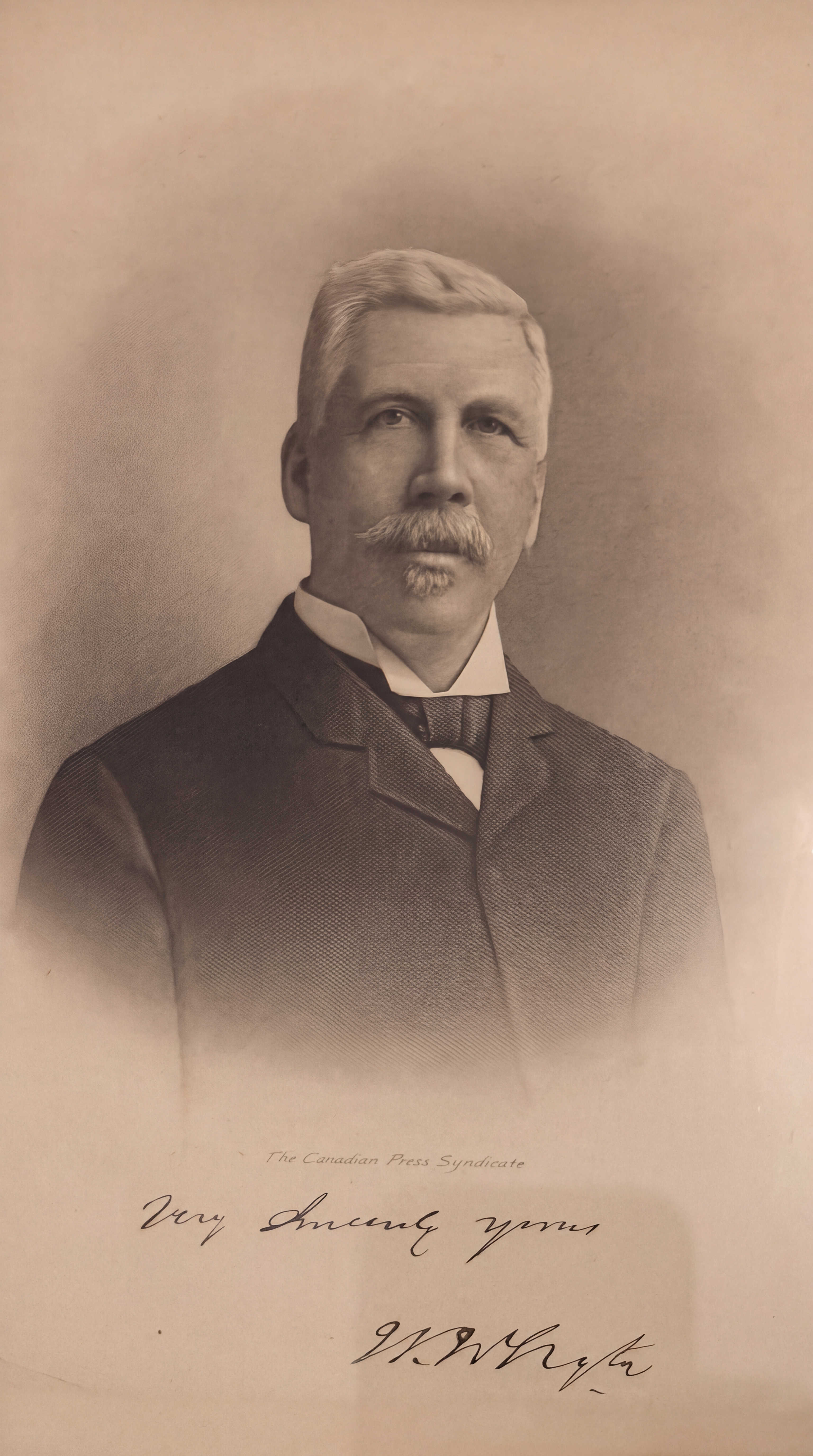
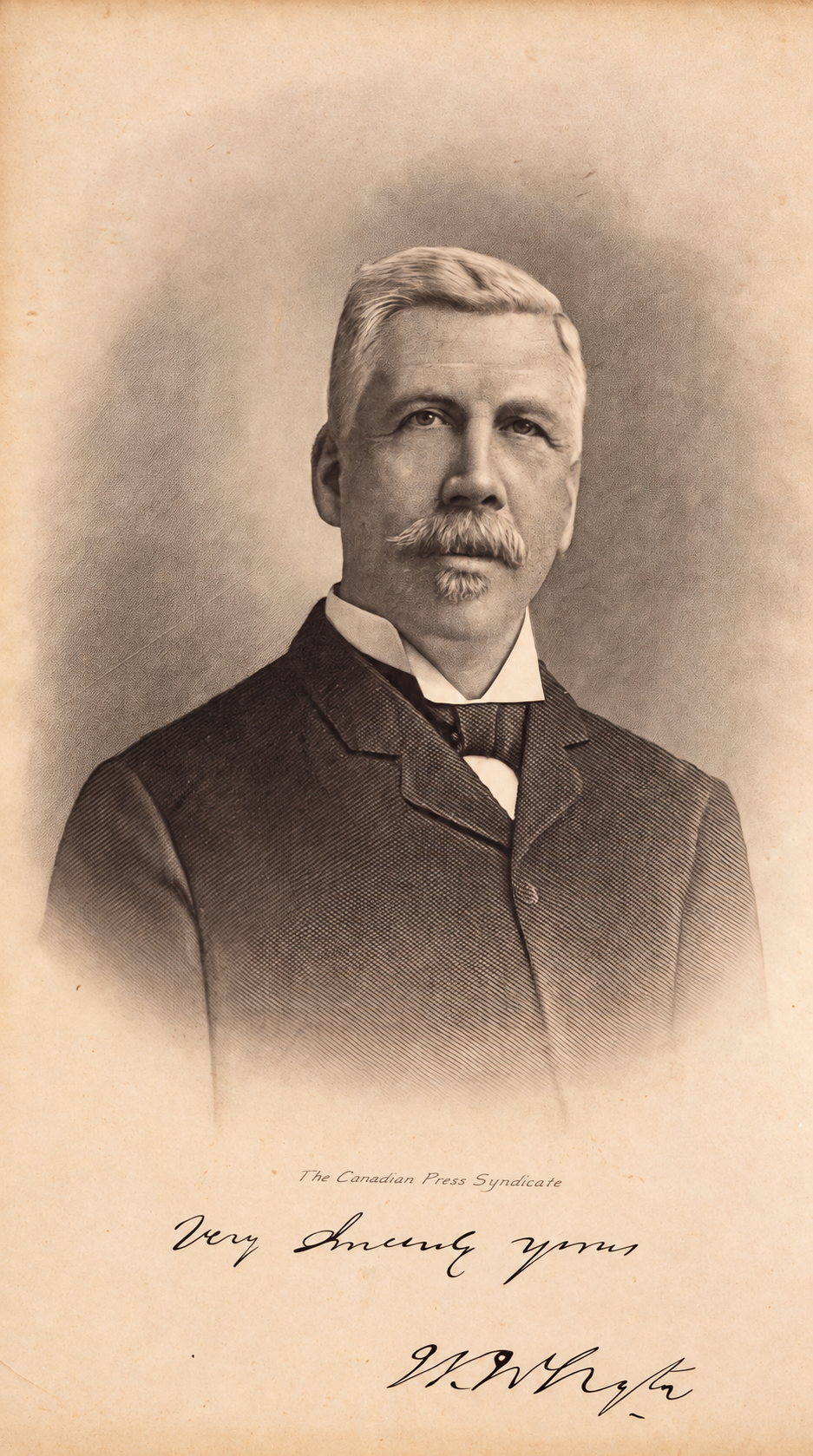
Sepia portrait of William Whyte, with a reproduced inscription and signature beneath.
Digitally enhanced portrait; William Whyte Hogan’s unaltered photograph of the original print.

I. Remembrance

22 April 1914

The afternoon the West stood still

Review draft. This opening preserves the family's proposed wording. The time of day, first-ever stoppage and presidency-vote claims remain unverified; see the verification and correction log.

At a quarter past three on 22 April 1914, every train on the Canadian Pacific stopped where it was. From Halifax to Vancouver, freights sat on sidings, passenger trains held at stations, yard engines went quiet. In Winnipeg the streetcars stopped too. For three minutes nothing moved on the railway that had made the country, and then it started again.

The man being buried had arrived in Canada fifty-one years earlier with a station agent's training and nothing else. He was twenty. He got a job as a brakeman on the Grand Trunk, riding the roofs of freight cars in Ontario winters to set the brakes by hand. He worked every job on a railway — switchman, clerk, foreman, yardmaster, conductor, stationmaster — before he ran one.

In 1886 the Canadian Pacific sent him west to Winnipeg. It was a town of twenty thousand on a mud river. When he retired twenty-five years later, everything on the CPR west of Lake Superior answered to him — fourteen hundred miles of main line, the branch lines feeding it, the towns strung along them, the grain that moved on it and the immigrants who came to grow it. The West that exists on the map today was, to an unusual degree, built along lines he decided to lay.

He did not run it from an office. Farmers climbed aboard his private car at Indian Head to argue for a branch line, and got one. When a rival railway tried to cross the CPR's tracks south of Winnipeg in 1888, he parked that car at the crossing and held it — the place is still called Fort Whyte. He wrote, in his own hand, that the prairie would fail without its forests and its water, and was ahead of his time in saying so. When two crews had argued for weeks about why oat cars kept breaking down, he suggested weighing the oats. It took three minutes.

Winnipeg buried him on a Wednesday. The lieutenant-governor walked in the procession. So did the premier, and the son of the prime minister who had built the railway. The president of the CPR came from Montreal — the man who had beaten him for that job by a single vote fifteen years before. The coffin was carried by engineers, firemen and machinists. The government of the province walked behind the men who ran the trains.

The railway had never stopped for anyone before — not for a president. When Van Horne himself died the following year, it stopped for him the same way. The precedent was set for a brakeman.

He was knighted by George V in 1911. A mountain above Lake Louise carries his name, and an avenue in Edmonton, and a beach on Lake Winnipeg, and a school. Almost no one knows why.

This is why.

Free Press, 23 April 1914 · Gibbons 1957 and contemporary Van Horne source: not yet located
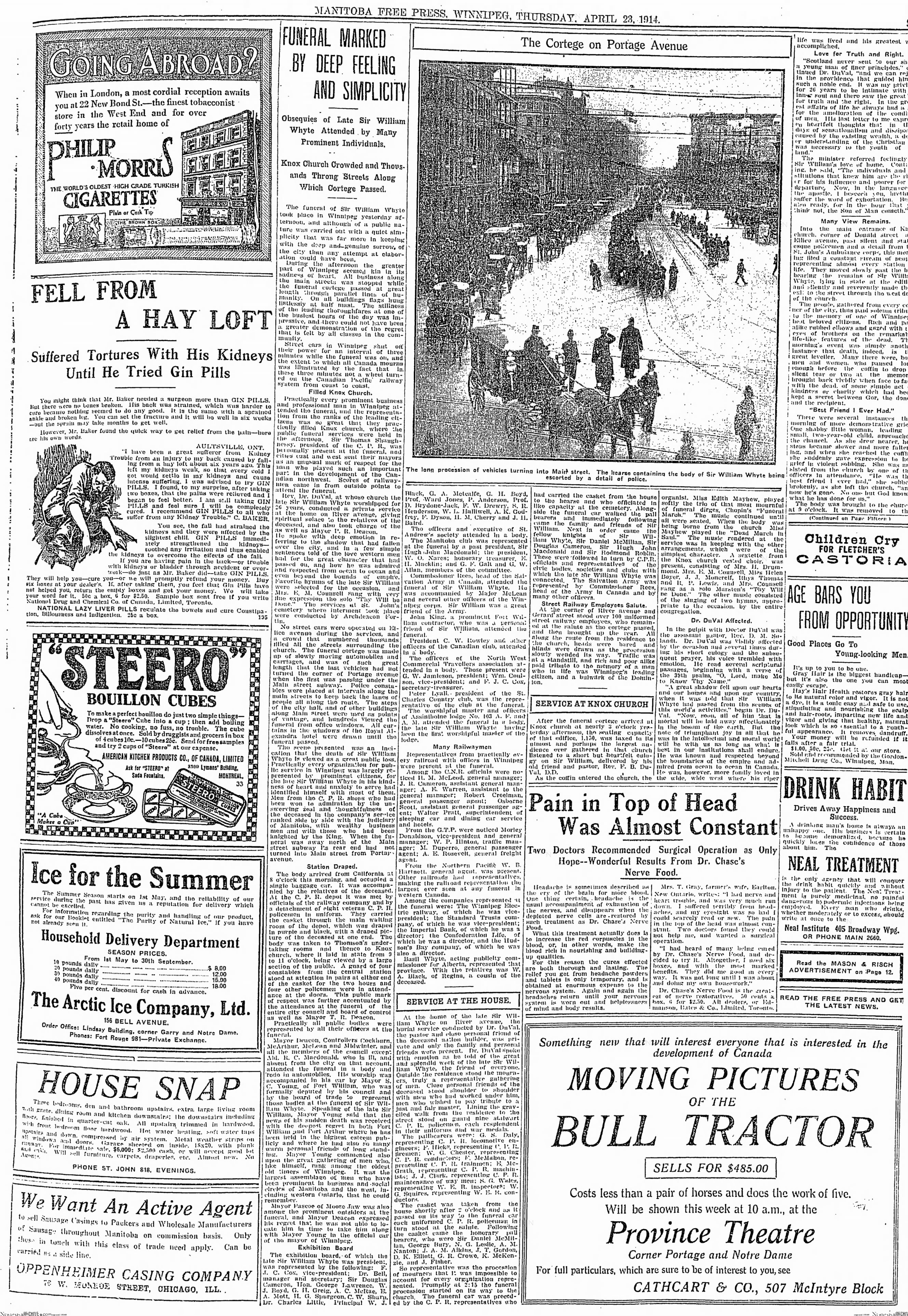
Newspaper photograph of Sir William Whyte's funeral cortege on Portage Avenue, turning into Main Street, Winnipeg.
The cortege on Portage Avenue. Manitoba Free Press, 23 April 1914. Original photograph and report. Cropped, paper-toned display; untouched scan.

Those who came to say farewell

The Free Press records who came. Sir Thomas Shaughnessy, president of the Canadian Pacific — the man who had taken the presidency from him in 1899 — travelled from Montreal. George Bury, who had succeeded Whyte as vice-president in charge of the West, was an honorary pallbearer. So were Sir Daniel McMillan, the former lieutenant-governor of Manitoba; Augustus Nanton, the Winnipeg financier whose firm sold CPR land-grant bonds; and James Aikins, the lawyer who would himself be lieutenant-governor in 1916.

Walking behind them: Sir Douglas Cameron, the sitting lieutenant-governor; Sir Rodmond Roblin, premier of Manitoba; and Sir Hugh John Macdonald, son of the prime minister who built the railway, and himself a former premier. The mayor of Winnipeg came with his council. Fort William sent its mayor roughly four hundred and twenty miles. The rival railways sent their officers, including Morley Donaldson, vice-president of the Grand Trunk Pacific. Commissioner Rees, who led the Salvation Army across Canada, was there too.

And the coffin itself was carried by working men — engineers, firemen, conductors, trainmen, machinists and the men who kept the track. The government of the province walked behind the men who ran the trains.

Attendance and pallbearers: 23 April 1914 · Roles and corrections

Public voices of remembrance

The April 22 obituary feature printed tributes from Sir Douglas Cameron, lieutenant-governor of Manitoba, and Sir Rodmond Roblin, the premier. Agricultural educator W. J. Black recalled Whyte's support for agricultural education and improved rural conditions. In British Columbia, CPR general superintendent F. W. Peters remembered the fairness and personal trust Whyte inspired among employees.

Obituary feature, 22 April 1914 · Peters's public tribute, 15 April 1914

II. A life in the making of Canada

“A Nation Builder”
A railwayman's beginnings.

“A Nation Builder” — Montreal Times, April 1914.

He arrived in 1863 with a station agent's training and no connections. Fifty years later the railway he helped build stopped to bury him.

William Whyte arrived in Canada in 1863 and began work as a brakeman on the Grand Trunk Railway. He rose through its ranks before joining the railway system that became part of the Canadian Pacific. In 1886, his work brought him to Winnipeg.

His responsibilities would stretch from Lake Superior to the Pacific. He helped turn a transcontinental railway into a working connection between farms, towns, markets and ports. Grain transportation, branch lines, irrigation and the growth of Winnipeg were not simply company business: they were part of the making of a country.

By 1904 he ran everything west of Lake Superior. He was knighted at the Coronation of George V in 1911, and kept on the board past retirement age because the company did not want to lose him.

Career and national significance: the biography below and the 1905 interview. Honours and mourning: contemporary reports.

Read the scholarly biography
1843Born in Fife, Scotland
1863Emigrates to Canada
1886Moves to Winnipeg for the CPR
1911Knighted; retires to the CPR board
1914Dies on April 14

Biography and chronology: Dictionary of Canadian Biography.

III. National recognition & remembrance

1911 – 1914

Honoured by the Crown.
Mourned across the country.

“The West's most distinguished private citizen”

The Coronation honours, 1911

William Whyte becomes Sir William

Whyte's knighthood formed part of King George V's Coronation honours.

The Winnipeg Tribune reported on June 20, 1911 that congratulatory telegrams were arriving from every part of the Dominion. Messages came from senior railway officers, but also from men travelling into Winnipeg on the Selkirk train.

The paper described a conviction in the CPR offices that no western Canadian was more deserving, and linked that regard to his work for the West, not merely his railway position. Winnipeg took the knighthood as its own.

Read the knighthood report, 20 June 1911 →

On the Atlantic & Pacific

Flags lowered across the fleet

The tribute extended beyond the rails. On April 15, the Vancouver Daily World reported flags at half-mast on CPR boats and buildings. It specifically described the company's fleet of more than 70 vessels on the Atlantic and Pacific carrying the tribute.

In the same report, F. W. Peters remembered the respect and affection Whyte commanded among employees, and the public trust he had earned. A week before the funeral, seventy ships were already flying their flags at half-mast for him.

Read the fleet and employee tribute, 15 April 1914 →

IV. Character in action

A contemporary remembrance · 1914

The Man Who Used Commonsense

“Suppose you weigh those oats.”

Cars carrying oats from Edmonton were suffering hot bearings and damage. The repair men blamed overloading; the loading crews insisted they had kept to the marks. According to the 1914 account, the dispute had lasted for weeks when Whyte suggested weighing the grain.

The marks assumed a bushel weighed 34 pounds. These oats weighed 40 to 46. The volume was right; the weight was not. The story credits him with resolving the difficulty in three minutes by questioning the assumption behind the argument.

Read the conclusion on page 133 · Story begins on printed page 131

A directorship earned in trust

Whyte retired from executive service in 1911 and joined the CPR board. Arbuthnotte's tribute explains the appointment in terms of more than managerial ability: the railway valued the confidence western Canadians placed in the man himself.

The same profile describes a company reluctant to lose him after he had passed its retirement age. In that telling, the directorship preserved a relationship built over decades between the railway, its employees and the West.

The magazine gives the retirement year as 1912; the Dictionary of Canadian Biography says 1911. We follow the Dictionary on the date and the magazine on the reason.

The byline and the source

The original printed byline reads John Arbuthnotte, including the final “e.” The author has not been established as John Arbuthnot, Winnipeg's former mayor. No claim of personal acquaintance is inferred from the similar names. This is an admiring contemporary tribute, not a corporate record.

Inspect the original title and byline, printed page 104

V. In his own words

Canada West · Vol. VI · July, No. 3

The War
Against Waste

In this illustrated essay, Whyte argues that forests and water must be protected together. He calls for tree planting, careful management of watersheds, and stronger fire prevention along railway lines.

He also acknowledges that conservation serves the railway's own interests. This is a case for responsible development, written in his own voice.

Read the original article

Original scanned pages 147–155. The year is not shown in this extract.

For dependable water
we must have woods.

William Whyte — The War Against Waste, p. 155

“We railway men are not altogether unselfish in our anxiety to protect the forests of Canada.”

VI. Beyond the appointments

From the family newspaper collection

The work, the arguments,
the man remembered.

A voice for forests

His argument against waste did not begin with the magazine essay. In April 1904, a newspaper report already had him urging that felled trees be replaced. Forest renewal took years; delay only made the task harder.

On July 30, 1909, the Vancouver Daily World quoted his Canada West writing on forests and water. That gives the undated family extract a valuable chronological anchor: the argument was in print by then.

19 April 1904 · 30 July 1909

The cost of settling

Railways needed traffic, and prairie settlers needed fuel, timber and reliable harvests. In 1904, Whyte threatened railway competition with lumber suppliers if prices remained too high. His concern for affordable homes accompanied a clear business interest in successful settlement.

Allen West's long 1905 interview opens a wider window on his outlook: farming, livestock, coal, career choices and his defence of the CPR at Fort Whyte. It is a rich source of his own explanations, not an impartial verdict on them.

8 January 1904 · 8 July 1905 interview

Courtesy and conflict

Colleagues remembered an approachable chief who treated subordinates fairly. Yet praise for his personal manner does not settle every question about railway power or labour. In 1900 he criticized the effects of British Columbia's eight-hour legislation; in 1903 ministers protested Sunday railway construction.

These reports belong beside the tributes. They reveal a manager defending his employer's interests, negotiating practical pressures and attracting criticism as well as loyalty.

3 March 1900 · 2 November 1903 · Peters's tribute

Standing beyond his office

The tributes did not remember Whyte only as a powerful executive. They recalled a trusted neighbour, an approachable man and a public figure to whom people turned. John Arbuthnotte's 1914 magazine profile placed him among the foremost makers of the country west of the Great Lakes.

The Tribune's editorial after the funeral emphasized character rather than rank: his courtesy, modesty and attachment to Burns's democratic ideals. Men who had reason to fear him did not. That is rarer than a knighthood.

The Man Who Used Commonsense, 1914 · A demonstration of respect

Reports of western development often present land and resources through the interests of railways and settlers. They are not a complete account of the Indigenous communities whose homelands were being transformed.

VII. A working life on the rails

People, crops & communities

The West came to his door.
Sometimes aboard his train.

A railway for Abernethy

Parks Canada's account of W. R. Motherwell tells of farmers boarding Whyte's train at Indian Head in 1903. They wanted a branch line through Abernethy. In his private car, Whyte asked how far they intended to travel. Motherwell's answer was that they would stay as long as it took to get the railway.

The account says they secured their line: a memorable encounter between a railway executive and the farmers whose livelihoods depended on access to market.

Parks Canada: Motherwell Homestead

Manitoba: following the private car

The family remembers his car as the Manitoba. It was more than transport. In 1888, during the standoff with a rival railway south of Winnipeg, it was his headquarters — the place the newspapers named Fort Whyte. In 1903 farmers climbed aboard it at Indian Head to argue for a branch line, and got one.

What the car was, exactly, is still being traced. A private car numbered 15 is recorded with Whyte on an 1897 excursion. A car that carried the name Manitoba was preserved by the Canadian Railroad Historical Association in 1957. Whether they are the same car has not been established, and no photograph has yet been securely identified. When one is, it goes here.

1897 excursion account · 1957 preservation report

Bringing in the harvest

In July 1911 the Winnipeg Tribune reported Whyte's arrangements to bring harvest workers from Britain and the United States. Recruitment, immigration arrangements and railway accommodation all had to meet the seasonal demands of the prairie crop.

The report's projected movement of tens of thousands of workers shows the scale of the task. It is evidence of planning, rather than a final count of arrivals.

Harvest arrangements, 17 July 1911

Fort Whyte: resolve and resistance

In 1888 Whyte defended the CPR's position against a rival railway crossing near Winnipeg. His private car served as a base during the confrontation. The name Fort Whyte survived long after the immediate dispute.

It is a story of determination, but also of competing public interests: Manitoba sought railway competition while Whyte defended his company. The province wanted competition. Whyte's job was to stop it. Both were right, and the name stuck.

Scholarly account · 1914 retrospective

VIII. His name on the landscape

Alberta & Manitoba

An avenue, a beach community,
a mountain.

Edmonton, Alberta · Namesake

Whyte Avenue

The avenue at the heart of Old Strathcona carries the railwayman's name. Travel Alberta explicitly identifies Sir William Whyte as its namesake, connecting a familiar Edmonton address to his western railway career.

Travel Alberta's account ↗

Dunnottar, Manitoba · Namesake

Whytewold

The strongest match for the family's recollection of “Whyte beach” is Whytewold, on Lake Winnipeg. Dunnottar's municipal development plan says the CPR developed the resort community in the early twentieth century and that it was named after Sir William Whyte.

Whytewold later joined Ponemah and Matlock in the Village of Dunnottar. It should not be confused with Winnipeg Beach, another lakeside place connected with him.

Dunnottar development plan, sections 1.1–1.2 ↗

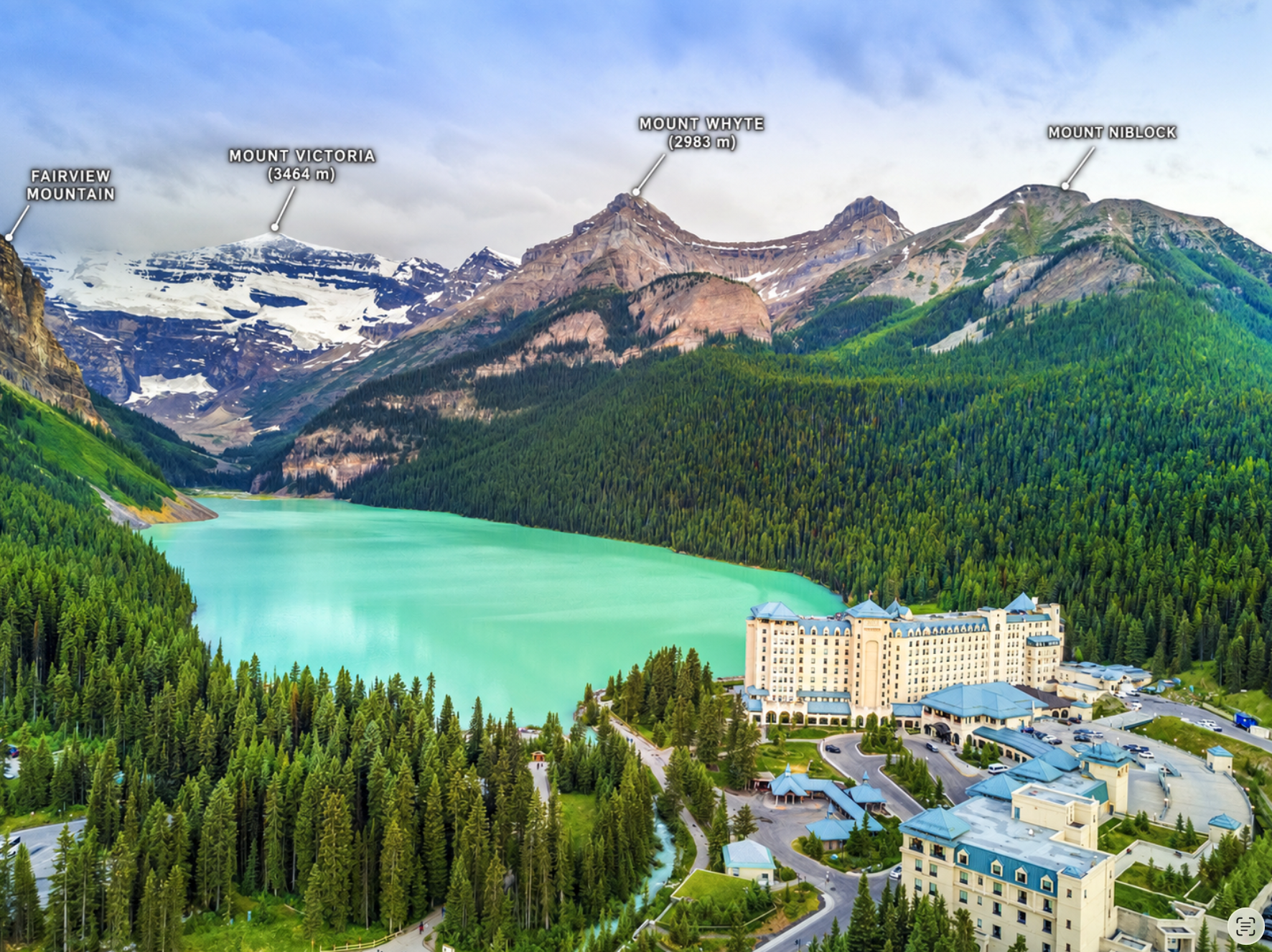
Banff National Park, Alberta · Namesake

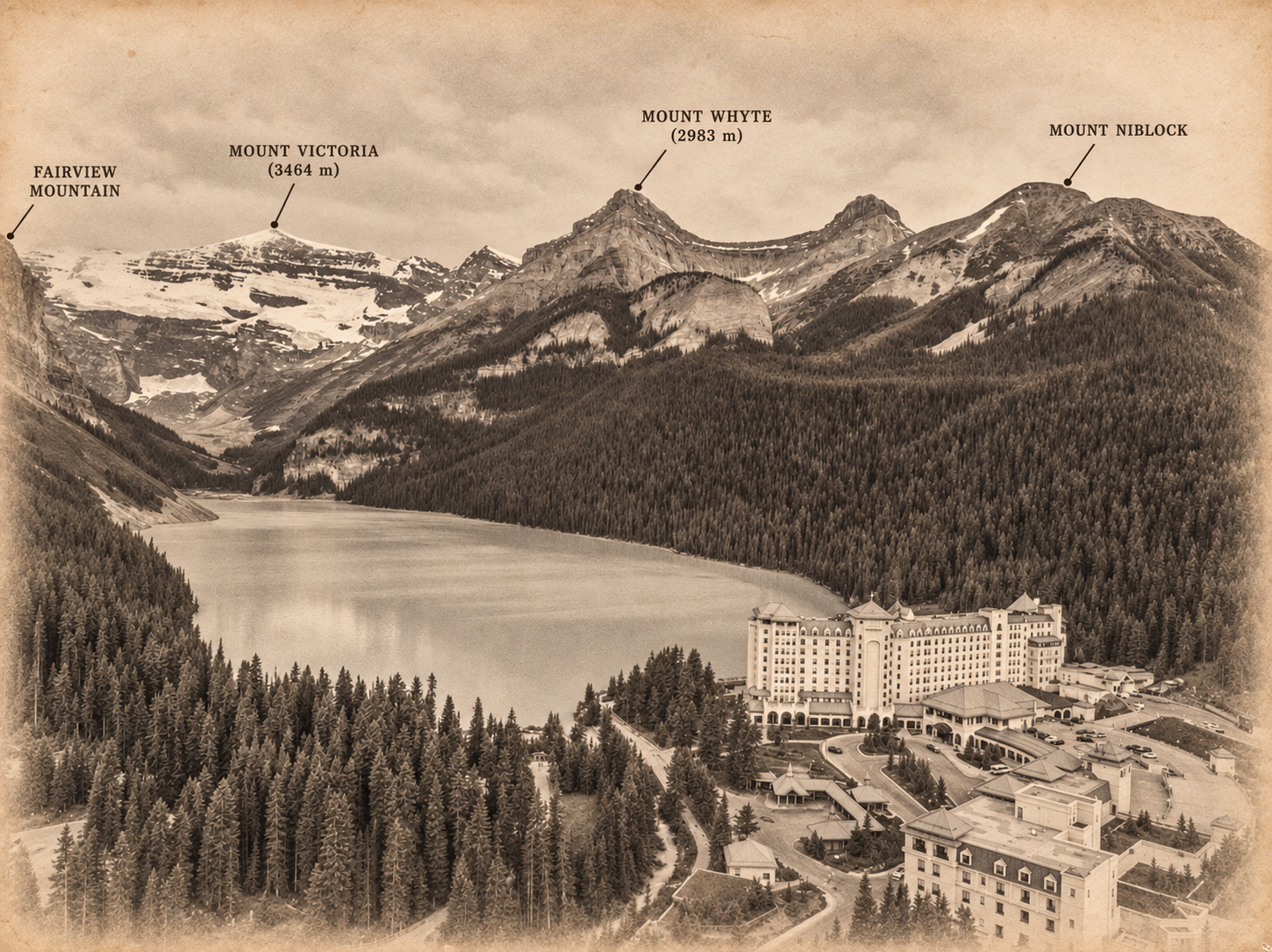
Mount Whyte

Sepia-treated view across Lake Louise, with Mount Whyte labelled above the lake and neighbouring peaks identified.
Mount Whyte above Lake Louise. AI-assisted sepia treatment of a modern view; untouched supplied original.

Official geographical name · Parks Canada map · Published naming account · 1928 clipping

Lake Winnipeg, Manitoba · Development connection

Winnipeg Beach

This is a connection through development, not a place named after Whyte. A Manitoba Historical Society study describes Whyte, Captain William Robinson and Charles Roland travelling along the lakeshore in 1901 to select a resort site.

The resulting railway excursions made the beach part of Winnipeg's leisure life. That resort history is one chapter in a shoreline with a much longer Indigenous history.

Winnipeg Beach by Moonlight, Manitoba History ↗

Winnipeg, Manitoba · Railway conflict

Fort Whyte & Whyte Ridge

The name Fort Whyte recalls the 1888 confrontation over a rival railway crossing CPR tracks. Whyte's defence of the company's position left a place-name that outlasted the dispute. Whyte Ridge's community history traces its name to the same episode.

Dictionary of Canadian Biography · Whyte Ridge community history

IX. At home in Winnipeg

River Avenue · The Whyte family

A home on River Avenue.

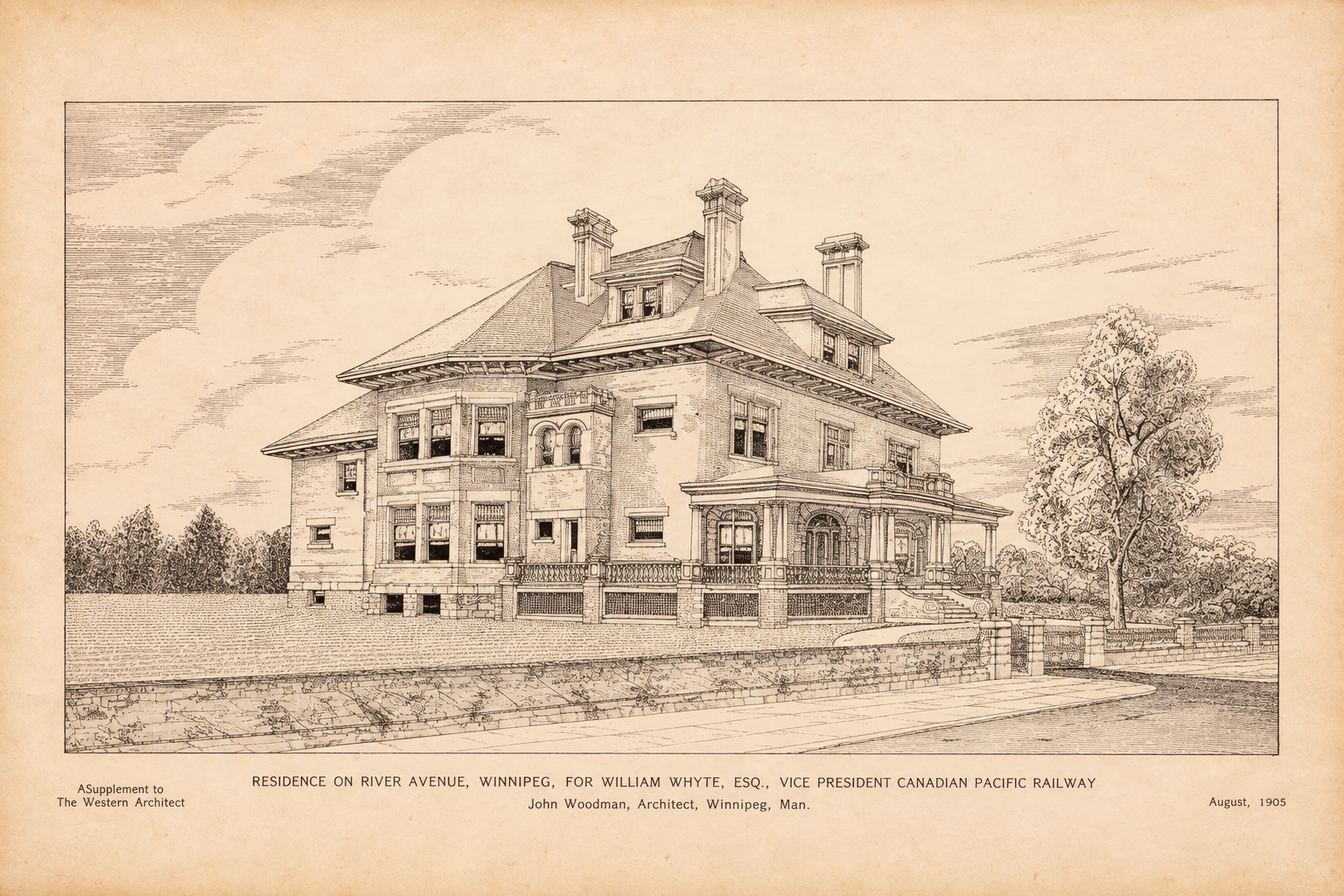
John Woodman's architectural perspective of William Whyte's River Avenue residence, with broad porches, dormer windows and tall chimneys.
Residence for William Whyte, vice-president of the Canadian Pacific Railway. John Woodman, architect. The Western Architect, August 1905. Untouched original published plate. Sepia-treated presentation.

The address behind the public life

The architectural plate names Whyte and his River Avenue residence. Twenty-five years later, Lady Whyte's obituary identifies the family home as 603 River Avenue. The 1914 funeral report also describes a private service at the River Avenue house before the public service at Knox Church.

The drawing records the architect's design, not a photograph of the completed building. The University of Winnipeg's pictorial catalogue separately lists a photograph of Whyte's River Avenue home, dated about 1920; that image remains to be obtained.

Lady Whyte's obituary, 1930 · The service at the house, 1914

Jane Scott, Lady Whyte

William married Jane Scott in Toronto in April 1871. Her obituary places her birth in Morrisburg, Ontario, and names her parents as Adam and Margaret Scott. The family made its home in Winnipeg in 1886.

She had a public life of her own, serving on the board of management of the Winnipeg Children's Home and participating in Knox Church. Her 1930 obituary recalled charitable work carried out without seeking publicity.

Read her obituary, 8 December 1930

The five surviving children named in 1930

Branches of the family

Lady Whyte's obituary names one son and four daughters, twelve grandchildren and one great-grandchild. The newspaper uses married names for the daughters; those forms are preserved below.

William Whyte
Son; Winnipeg manager of the Huron and Erie Mortgage Corporation.
Mrs. J. Frank Fisher
Daughter; Winnipeg.
Mrs. James A. Hunter
Daughter. Christine Methven Whyte, called Teeny, married James A. Hunter of the Hunter Land Company, Minneapolis. Lady Whyte's 1930 obituary lists her at Winnipeg; when she returned, and whether she was widowed by then, is not yet settled. This site's author descends from her through her son, William Whyte Hunter.
Mrs. Charles S. Meek
Daughter; Winnipeg.
Mrs. Creighton
Daughter; Montreal.

This is a documented family outline, not a complete genealogical register. Published accounts disagree on the total number of children and infant deaths. Individual wedding dates and the full descendant tree remain under investigation. The family's surviving heirlooms follow below.

X. An open question

Newspaper accounts & the boardroom record

A presidency decided by one vote?

Two later newspaper accounts say that Whyte narrowly lost the CPR presidency to Thomas G. Shaughnessy through the chairman's casting vote.

The story is compelling. The distinction matters: the succession is documented in 1899, but the tie-breaking ballot has not yet been verified against the board minutes.

17 June 1899

Commercial and Financial Chronicle

The contemporary announcement

Reports the board's acceptance of Van Horne's resignation and election of Shaughnessy. The notice supplies neither a vote count nor a reference to Whyte.

Read the issue ↗
Succession documented
15 April 1914

Winnipeg Tribune · Page 4

About Sir William

“He only lost the great post by the casting vote of the chairman.” An explicit account published fifteen years after the succession.

View the clipping ↗
Retrospective account
14 December 1935

Winnipeg Tribune · Page 10

A Western Railway Builder

Repeats the account of a close contest and a deciding ballot. Appearing in the same newspaper, it is not necessarily an independent source.

View the clipping ↗
Later retelling

XI. The family collection

Objects, memory & inheritance

History held in the hand.

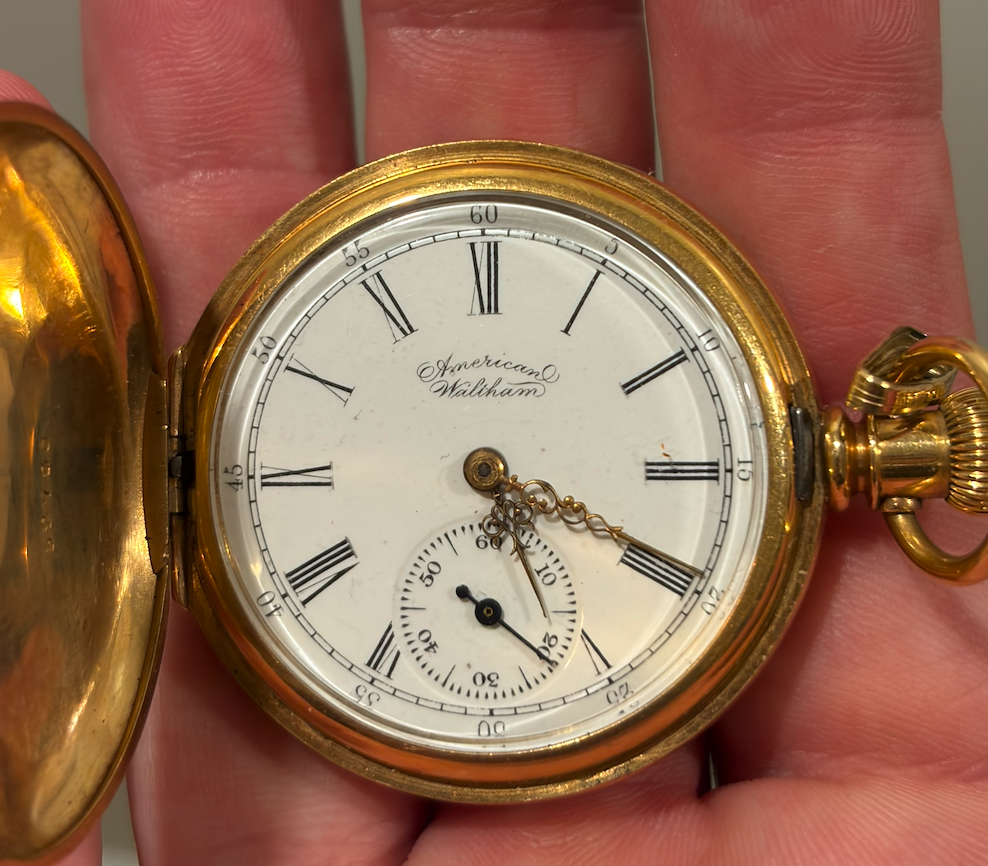
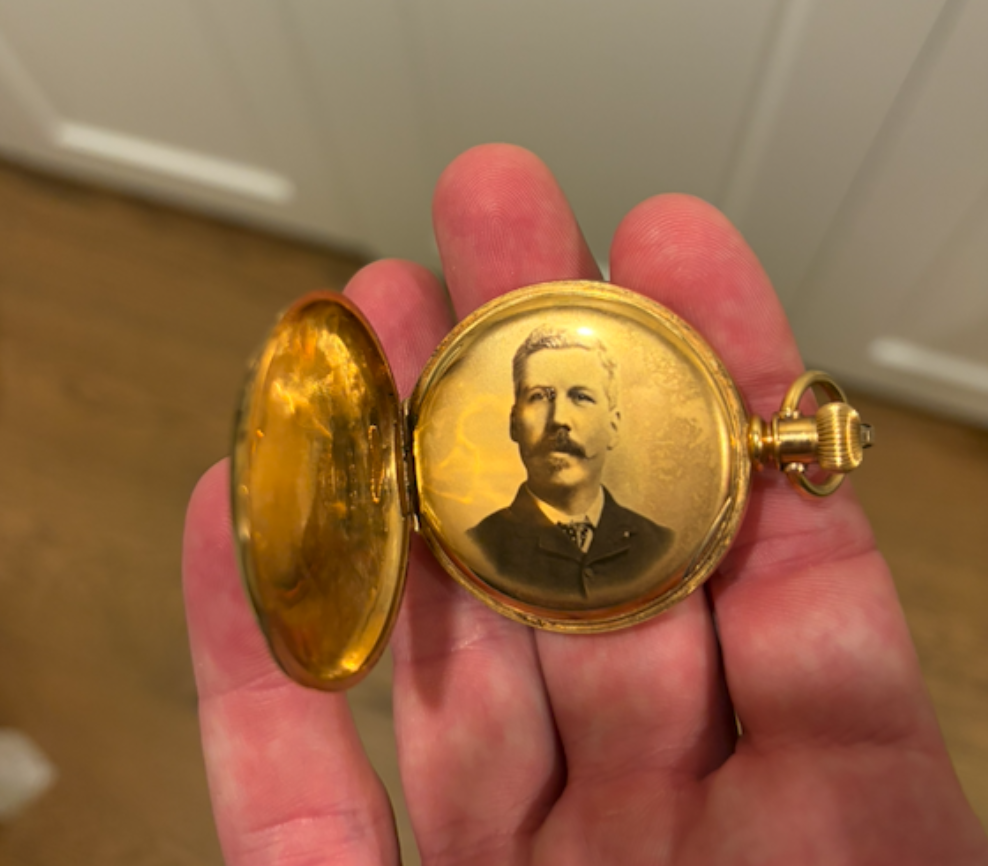
These are the things that were not thrown out. A steel-engraved portrait, signed 'Very sincerely yours, W. Whyte,' that hangs in an office in North Vancouver. A Waltham pocket watch with his monogram on the case and his younger face inside the lid, worn as jewellery by a teenage girl in Minneapolis in the 1950s and never lost. In 1942 the same family gave his grandfather clock to the Manitoba Club, where a plate still carries William Whyte Hunter's name.

William Whyte Hogan, Sir William's great-great-grandson, recalls that both objects came through his grandfather, William Whyte Hunter, who received them from his mother, Christine Methven Whyte, Sir William's daughter.

The portrait is now in William Hogan's office. The watch remains with his mother. His wish is for both to pass in turn to his daughter, Willow Whyte.

Sir William Whyte → Christine "Teeny" Whyte Hunter → William Whyte Hunter → Diane Ashley Hunter → William Whyte Hogan → Willow Whyte.

Six generations. Five of them carry the name.

Provenance as recounted by William Whyte Hogan. The watch's date, case material and movement have not been independently assessed.

XII. Sources & notes

A history worth
getting right.

This collection brings together published history, original writing and family recollections. Unresolved questions remain identified as such.

The portrait shown here is a family-supplied digital image. Where an image on this site has been enhanced, toned, or cropped for display, the caption says so and links the untouched original.

  1. A. A. den Otter, “Whyte, Sir William”Dictionary of Canadian Biography, vol. 14, 1998.
  2. Memorable Manitobans: William Methven WhyteManitoba Historical Society.
  3. William Whyte, “The War Against Waste”Canada West, vol. VI, July, no. 3, pp. 147–155.
  4. George Bryce, The Scotsman in CanadaVolume II, 1911, chapter XXX. A contemporary, admiring account.
  5. Exporail Archives and Documentation CentreCanadian Pacific Railway Company fonds, P170.
  6. John Arbuthnotte, The Man Who Used CommonsenseCanada Monthly, 1914, printed pp. 104–105, 131, 133–134. Byline checked against the scan.
  7. The River Avenue residenceThe Western Architect, August 1905, architectural plate by John Woodman.
  8. Lady Whyte's obituaryWinnipeg Tribune, 8 December 1930, p. 2. Family and home evidence.
  9. Comment, anecdote and tributeWeekly Free Press and Prairie Farmer, 22 April 1914, p. 2.

Corrections & open questions

28 September 2026: Portrait provenance clarified by William Whyte Hogan; his photograph of the original print is linked beneath the enhanced portrait. Watch custody and the six-generation line reflect his supplied family record.

28 September 2026: The unverified Mount Whyte namer and date have been removed; the elevation follows the linked Parks Canada map. The Hunter residence discrepancy remains open against Lady Whyte’s 8 December 1930 obituary; James A. Hunter’s exact death date is not yet verified.